
The recently discovered Free Download Manager (FDM) supply chain attack, which distributed Linux malware, started back in 2020.
The maintainers of Free Download Manager (FDM) confirmed that the recently discovered supply chain attack dates back to 2020.
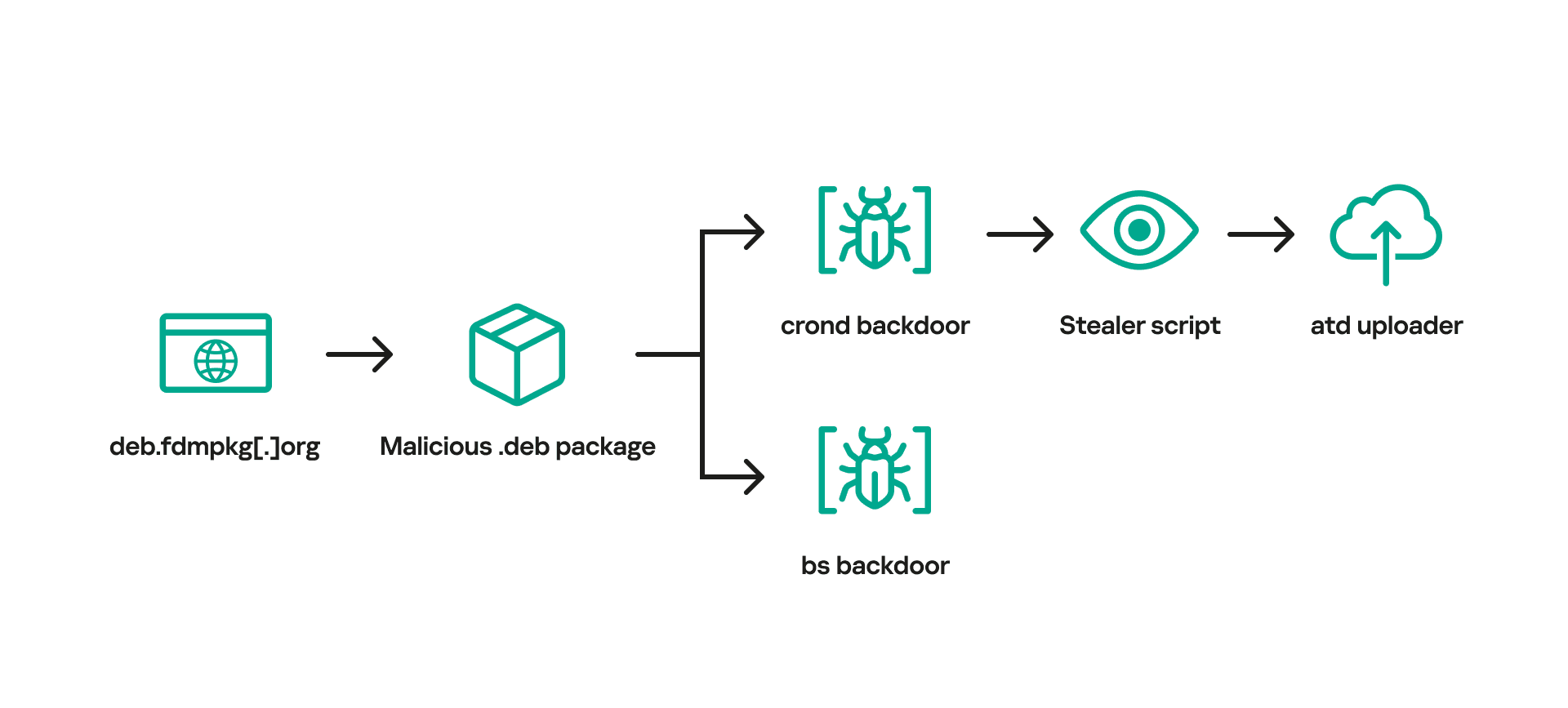
Recently, researchers from Kaspersky reported the discovery of a free download manager site that has been compromised to serve Linux malware. While investigating a set of suspicious domains, the experts identified that the domain in question has a deb.fdmpkg[.]org subdomain.
Visiting the subdomain with the browser, the researchers noticed a page claiming that the domain is hosting a Linux Debian repository of software named ‘Free Download Manager’
This package turned out to contain an infected postinst script that is executed upon installation. This script drops two ELF files to the paths /var/tmp/crond and /var/tmp/bs. It then establishes persistence by creating a cron task (stored in the file /etc/cron.d/collect) that launches the /var/tmp/crond file every 10 minutes.” reported Kasperksy.
The “Free Download Manager” version installed by the malicious package was released on January 24, 2020. The experts found comments in Russian and Ukrainian, including information about improvements made to the malware, in the postinst script.
Upon installing the malicious package, the executable /var/tmp/crond is launched on every startup through cron. The executable is a backdoor that accesses the Linux API and invokes syscalls using the statically linked dietlibc library.
Now the maintainers of Free Download Manager (FDM) have shared findings from their investigation. They discovered that a Ukrainian hacker group compromised a specific web page on their web site then used it to distribute the malware.
“Today, informed by the findings from Kaspersky Lab, we became aware of a past security incident from 2020. It appears that a specific web page on our site was compromised by a Ukrainian hacker group, exploiting it to distribute malicious software.” reads the announcement published by the maintainers. “Only a small subset of users, specifically those who attempted to download FDM for Linux between 2020 and 2022, were potentially exposed. It’s estimated that much less than 0.1% of our visitors might have encountered this issue. This limited scope is probably why the issue remained undetected until now. Intriguingly, this vulnerability was unknowingly resolved during a routine site update in 2022.”
The maintainers estimate that the website served the malware to a very limited number of visitors, the maintainers believe that much less than 0.1% of their visitors were impacted. For this reason, the supply chain attack remained undetected for years.
The maintainers announced the enhancement of their defenses and the implementation of additional measures to prevent similar security incidents in the future.
Visitors who attempted to download FDM for Linux from the compromised page during the mentioned timeframe are recommended to scan their systems for the presence of malware and update their passwords.
The maintainers determined that the threat actors exploited a vulnerability in a script on their website to inject the malicious code.
The analysis of files that were part of the site before the compromise (dating back to 2020) revealed the presence of a portion of code used to choose whether to give users the correct download link or a link to the malware-laced version of the files.
“To investigate this problem, we accessed data from our project backups dating back to 2020 and found this modified page, which contained an algorithm that chose whether give users correct download link or the one leading to the fake domain deb.fdmpkg.org containing a malicious .deb file. It had an «exception list» of IP addresses from various subnets, including those associated with Bing and Google.” continues the announcement. “Visitors from these IP addresses were always given the correct download link.” continues the announcement.
FDM has released a script to check for indicators of compromise (IoCs).
Follow me on Twitter: @securityaffairs and Facebook and Mastodon
(SecurityAffairs – hacking, Free Download Manager)


