
The team conducted an experiment that involved 20 volunteer subjects, the researchers obtained their photos from online sources. It is a quite easy today to find images of a subject online, in this way act criminals that intend to steal our digital identity too.
A group of researchers demonstrated that a number of existing facial recognition systems can be fooled by 3D facial models made from Facebook photos.
Facial recognition systems still have a certain margin of error, for example, trying to identify people of color.
A group of researchers from the University of North Carolina demonstrated that a number of existing facial recognition systems can be fooled by 3D facial models made from photographs published on Facebook. The models are displayed with virtual reality applications running on mobile devices.
“Earlier this month at the Usenix security conference, security and computer vision specialists from the University of North Carolina presented a system that uses digital 3-D facial models based on publicly available photos and displayed with mobile virtual reality technology to defeat facial recognition systems.” reported Wired.
The team used the virtual reality technology to give motion and depth to the images in order to bypass facial recognition systems.
“The researchers used a VR system shown on a smartphone’s screen for its accessibility and portability.”

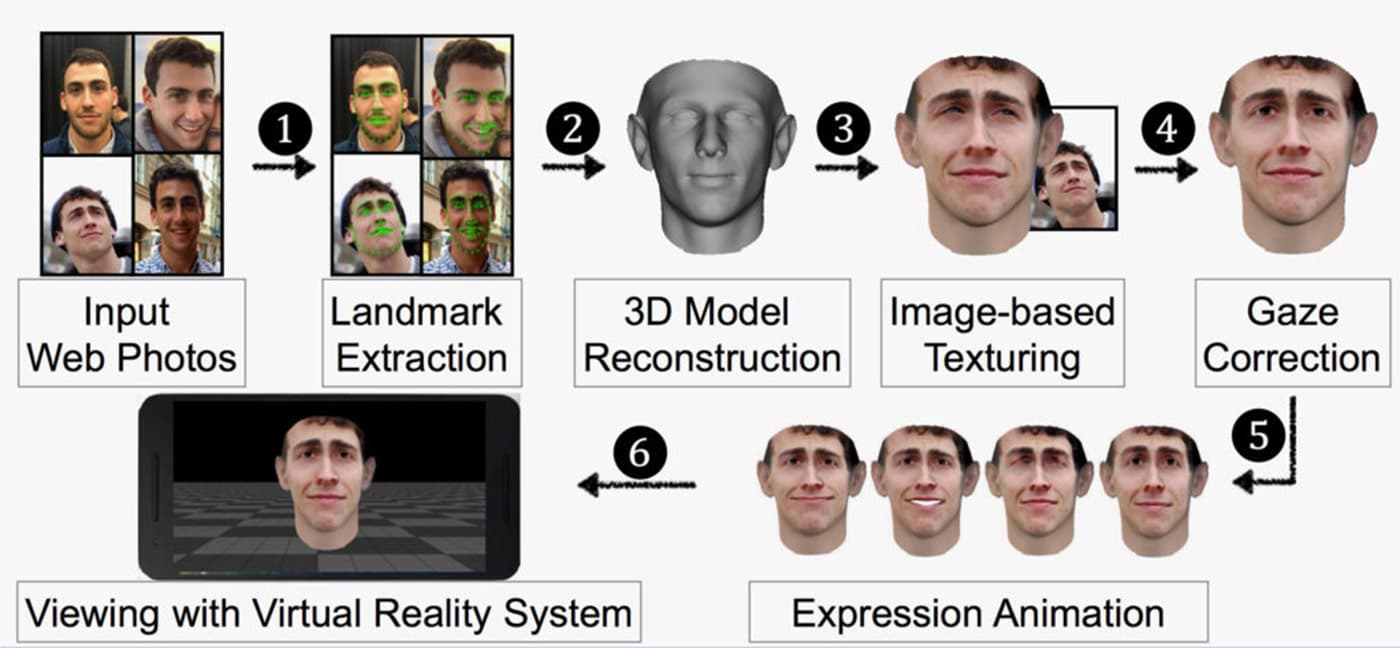
The process of preparing facial models for the attack. DEPARTMENT OF COMPUTER SCIENCE/UNC CHAPEL HILL (Source Wided)
Then the researchers created 3D models of the volunteers’ faces, they tweaked their eyes and added some facial animations to simulate the behavior of a man that is looking at the camera. In some cases, when they haven’t found online photos that showed the subject’s whole face, they have recreated the missing parts.
The experts tested their virtual reality face renders on five facial recognition systems used to authenticate users, KeyLemon, Mobius, TrueKey, BioID, and 1D. All these systems implement an authentication feature that can be used for a wide range of applications, such as locking smartphones.
The 3D models made by the researchers were able to fool four out of five facial recognition systems they tested 55 percent to 85 percent of the time. According to Wired, team member True Price said during the team’s presentation at the Usenix security conference:
“Using the control photos, the researchers were able to trick all five systems in every case they tested. Using the public web photos, the researchers were able to trick four of the systems with success rates from 55 percent up to 85 percent”
In order to improve the efficiency of these systems, it is also possible to combine also an image captured by an infrared camera, in this case, 3D model cannot fool the facial recognition systems.
VR systems, in fact, are not able to reproduce human infrared signals.
[adrotate banner=”9″]
(Security Affairs – Virtual reality, facial recognition systems)


