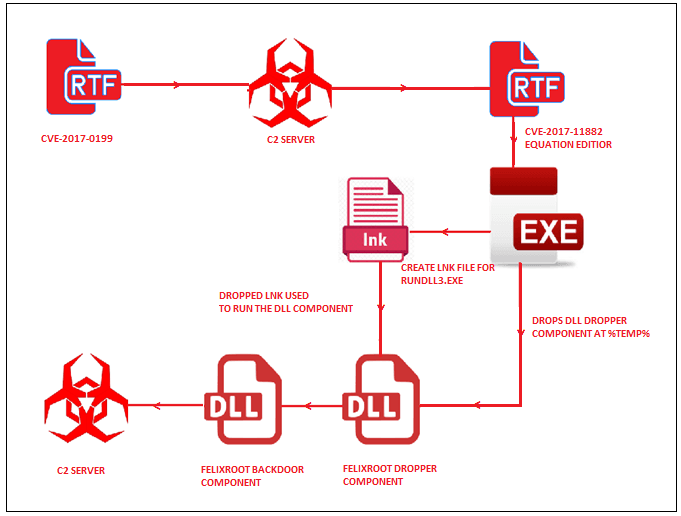
The FELIXROOT backdoor was first spotted by FireEye in September 2017, when attackers used it in attacks targeting Ukrainians.
The new spam campaign used weaponized documents claiming to provide information on a seminar on environmental protection efforts.
The documents include code to exploit known Microsoft Office vulnerabilities CVE-2017-0199 and CVE-2017-11882 to drop and execute the backdoor binary.
Experts reported that the lure documents used in the last campaign were written in the Russian language. The weaponized document exploits the CVE-2017-0199 flaw to download a second-stage payload that triggers the CVE-2017-11882 vulnerability to drop and execute the final backdoor.
“FireEye recently observed the same FELIXROOT backdoor being distributed as part of a newer campaign. This time, weaponized lure documents claiming to contain seminar information on environmental protection were observed exploiting known Microsoft Office vulnerabilities CVE-2017-0199 and CVE-2017-11882 to drop and execute the backdoor binary on the victim’s machine.” reads the analysis published by FireEye.
“After successful exploitation, the dropper component executes and drops the loader component. The loader component is executed via RUNDLL32.EXE. The backdoor component is loaded in memory and has a single exported function,”
The CVE-2017-0199 allows the attackers to download and execute a Visual Basic script containing PowerShell commands when the victim opens the lure document.
The CVE-2017-11882 is remote code execution vulnerability that allows the attacker to run arbitrary code in the context of the current user.

This backdoor implements a broad a range of features, including the target fingerprinting via Windows Management Instrumentation (WMI) and the Windows registry, remote shell execution, and data exfiltration.
Upon execution, the backdoor sleeps for 10 minutes, then it checks to see if it was launched by RUNDLL32.exe along with parameter #1.
If the backdoor was launched by RUNDLL32.exe with parameter #1 it makes an initial system triage before connecting to the command-and-control (C2). The malicious code uses Windows API to get the system information (i.e. computer name, username, volume serial number, Windows version, processor architecture and so on).
The FELIXROOT backdoor is able to communicate with its Command and Control server via HTTP and HTTPS POST protocols. The traffic to the C2 is encrypted with AES and converted into Base64.
“FELIXROOT communicates with its C2 via HTTP and HTTPS POST protocols. Data sent over the network is encrypted and arranged in a custom structure. All data is encrypted with AES, converted into Base64, and sent to the C2 server” continues the analysis.
“Strings in the backdoor are encrypt1ed using a custom algorithm that uses XOR with a 4-byte key.”
The experts believe that this backdoor is a dangerous threat but was involved at the time in massive campaigns.
FELIXROOT backdoor contains several commands that allow it to execute specific tasks. Once executed a command, the malicious code will wait for one minute before executing the next one.
“Once all the tasks have been executed completely, the malware breaks the loop, sends the termination buffer back, and clears all the footprints from the targeted machine” continues FireEye.
- Deletes the LNK file from the startup directory.
- Deletes the registry key HKCU\Software\Classes\Applications\rundll32.exe\shell\open
- Deletes the dropper components from the system.
Further details, including the IoCs are reported in the analysis published by FireEye.