
Researchers disclosed a remote code execution vulnerability, tracked as CVE-2022-25845, in the popular Fastjson library.
Cybersecurity researchers from JFrog disclosed details of a now patched high-severity security vulnerability in the popular Fastjson library that could be potentially exploited to achieve remote code execution.
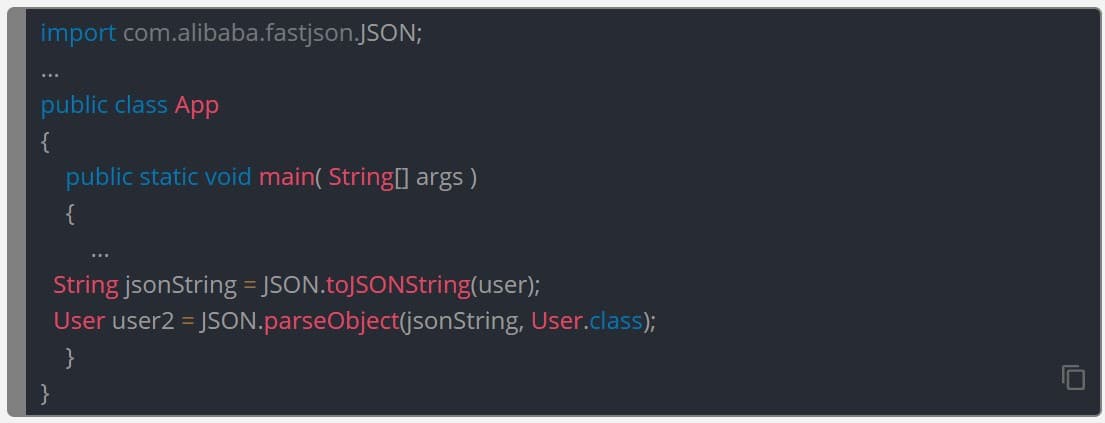
Fastjson is a Java library that can be used to convert Java Objects into their JSON representation. It can also be used to convert a JSON string to an equivalent Java object. Fastjson can work with arbitrary Java objects including pre-existing objects that you do not have source-code of.
The flaw, tracked as CVE-2022-25845 (CVSS score: 8.1), resides in a feature called “AutoType” and is related to the deserialization of untrusted data. The AutoType function allows specifying a custom type when parsing a JSON input that can then be deserialized into an object of a specific class.
“this vulnerability allows an attacker to bypass the “AutoTypeCheck” mechanism in Fastjson and achieve remote code execution.” reads the analysis published by JFrog’s Uriya Yavnieli.
The impact of this flaw is huge, it affects all Java applications that rely on Fastjson versions 1.2.80 or earlier and that pass user-controlled data to either the JSON.parse or JSON.parseObject APIs without specifying a specific class to deserialize. The experts pointed out that almost 5000 Maven projects rely on Fastjson.

The vulnerability was addressed with the release of version 1.2.83 on May 23, 2022.
Initially, the issue was addressed by the development team by introducing a safeMode that disables AutoType and implementing a blocklist of classes to defend against deserialization issues. Unfortunately, experts discovered how to bypass these restrictions to achieve remote code execution forcing the development team to introduce new fixes.
“To conclude, we assess that currently this vulnerability does not seem to pose a high threat. Although a public PoC exploit exists and the potential impact is very high (remote code execution) the conditions for the attack are not trivial (passing untrusted input to specific vulnerable APIs) and most importantly – target-specific research is required to find a suitable gadget class to exploit (which will probably not exist at all, due to its unlikely attributes).” Yavnieli concludes.
Security Affairs is one of the finalists for the best European Cybersecurity Blogger Awards 2022 – VOTE FOR YOUR WINNERS. I ask you to vote for me again (even if you have already done it), because this vote is for the final.
Please vote for Security Affairs and Pierluigi Paganini in every category that includes them (e.g. sections “The Underdogs – Best Personal (non-commercial) Security Blog” and “The Tech Whizz – Best Technical Blog”)
To nominate, please visit:
https://docs.google.com/forms/d/e/1FAIpQLSdNDzjvToMSq36YkIHQWwhma90SR0E9rLndflZ3Cu_gVI2Axw/viewform
Follow me on Twitter: @securityaffairs and Facebook
| [adrotate banner=”9″] | [adrotate banner=”12″] |
(SecurityAffairs – hacking, Fastjson library)
[adrotate banner=”5″]
[adrotate banner=”13″]


