Europe Confirms Record €4.1B Penalty Against Google for Android Practices|U.S. CISA adds a Microsoft SharePoint Server flaw to its Known Exploited Vulnerabilities catalog|430,000 FortiGate Devices Exposed in FortiBleed Ransomware Link|Adobe fixed multiple maximum-severity flaws in ColdFusion and Campaign Classic|Alleged Scattered Spider Hacker Extradited to U.S. to Face Cybercrime Charges|Oracle E-Business Suite Flaw Under Active Attack, 950 Systems Exposed|Azure CLI Targeted in LSHIY Password Spray Campaign Across 64 Orgs|CISA Warns BlueHammer Flaw Is Now Exploited in Ransomware Attacks|RustDuck: The Botnet That’s Still Small but Engineering Like It Plans to Grow|GuardFall Flaw Hits 10 of 11 Popular Open-Source AI Agents|XSS.is, The Forum That Ran the Ransomware Supply Chain Is Down. The Market Isn’t|U.S. CISA adds SimpleHelp flaw to its Known Exploited Vulnerabilities catalog|Europe Confirms Record €4.1B Penalty Against Google for Android Practices|U.S. CISA adds a Microsoft SharePoint Server flaw to its Known Exploited Vulnerabilities catalog|430,000 FortiGate Devices Exposed in FortiBleed Ransomware Link|Adobe fixed multiple maximum-severity flaws in ColdFusion and Campaign Classic|Alleged Scattered Spider Hacker Extradited to U.S. to Face Cybercrime Charges|Oracle E-Business Suite Flaw Under Active Attack, 950 Systems Exposed|Azure CLI Targeted in LSHIY Password Spray Campaign Across 64 Orgs|CISA Warns BlueHammer Flaw Is Now Exploited in Ransomware Attacks|RustDuck: The Botnet That’s Still Small but Engineering Like It Plans to Grow|GuardFall Flaw Hits 10 of 11 Popular Open-Source AI Agents|XSS.is, The Forum That Ran the Ransomware Supply Chain Is Down. The Market Isn’t|U.S. CISA adds SimpleHelp flaw to its Known Exploited Vulnerabilities catalog|
Advertisement

Ad Placeholder

Full Width × 90

Cyber Crime

Threat actors used the Extembro DNS-changer Trojan in an adware campaign to prevent users from accessing security-related websites. Security experts at Malwarebytes observed an adware campaign that involved the Extembro DNS-changer Trojan to prevent users from accessing websites of security vendors. “Recently, we uncovered a new DNS-changer called Extenbro that comes with an adware bundler. […]

extenbro trojan

Threat actors used the Extembro DNS-changer Trojan in an adware campaign to prevent users from accessing security-related websites.

Security experts at Malwarebytes observed an adware campaign that involved the Extembro DNS-changer Trojan to prevent users from accessing websites of security vendors.

“Recently, we uncovered a new DNS-changer called Extenbro that comes with an adware bundler. These DNS-changers block access to security-related sites, so the adware victims can’t download and install security software to get rid of the pests.” reads the post published by Malwarebytes.

The Extenbro Trojan is delivered by a bundler that is tracked by the security firm as Trojan.IStartSurf.

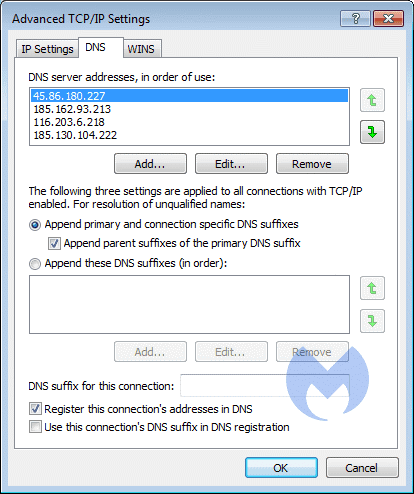
The Extenbro Trojan is used to change the DNS settings, victims can only notice that it adds four DNS servers to the Advanced DNS tab in Windows.

extenbro trojan

To malware gain persistence by creating a randomly-named Scheduled Task that points to a fixed-location folder.

The Extenbro Trojan adds a certificate to the set of Windows Root certificates, it has no “Friendly Name” and experts believe it was registered to abose[at]reddit[dot]com.

The malware also disables IPv6 by changing the registry value DisabledComponents under the key HKEY_LOCAL_MACHINE\SYSTEM\CurrentControlSet\services\TCPIP6\Parameters. Thus, it forces the system to use the new DNS servers.

On top of that, the Trojan makes a change in the Firefox user.js file and configures the browser to use the Windows Certificate Store where its root certificate was added.

The Extenbro Trojan also modifies the Firefox user.js file and sets the security.enterprise_roots.enabled setting to true, in this way it forces Firefox to use the Windows Certificate Store that includes the newly-added root certificate.

The analysis published by Malwarebytes includes the removal instructions.

To restore their DNS settings, users should remove the DNS entries added by the malware from the DNS advanced settings without rebooting the system.

“To get to your security sites, you may need a restart of the browser. Do NOT reboot your system or the DNS servers might be changed for the worse again by the Scheduled Task that belongs to the Trojan. If your existing solution does not pick up on the malware, download  Malwarebytes to your desktop.” concludes the analysis.

To restore Firefox to the initial settings, users should type about:config in the address bar, search for security.enterprise_roots.enabled and change it to the default setting, “False.”

[adrotate banner=”9″] [adrotate banner=”12″]

Pierluigi Paganini

(SecurityAffairs – Extembro Trojan, adware)

[adrotate banner=”5″]

[adrotate banner=”13″]