Security Affairs
Love Electric Breach: 877,000 Driver Records Offered for $600|Trump Targets Foreign Technology in New U.S. Power Grid Security Order|U.S. CISA adds ownCloud, Linux Kernel, and JFrog Artifactory flaws to its Known Exploited Vulnerabilities catalog|Russian APT BlueDelta Uses HOOKEDGE to Target Defense and Diplomatic Organizations|PaperCut Zero-Day Under Active Attack: Emergency Patch Released|U.S. CISA adds Red Hat, Linux Kernel, Ajax.NET Professional, Microsoft SQL Server, and Citrix NetScaler flaws to its Known Exploited Vulnerabilities catalog|Cyberattack on UK Airport Operator MAG Exposes Data of 8.7 Million Customers Across Three Airports|Dark Caracal Deploys New Go Malware With Ethereum-Based C2 Fallback|Australian Police Charge Two Over TeamPCP Credential Theft|Meta to Pay Up to $18B Over Teen Social Media Use|CISA Warns Water Utilities: Find Your Exposed PLCs Before Attackers Do|OpenAI banned Russian ChatGPT accounts backing covert influence operation|Love Electric Breach: 877,000 Driver Records Offered for $600|Trump Targets Foreign Technology in New U.S. Power Grid Security Order|U.S. CISA adds ownCloud, Linux Kernel, and JFrog Artifactory flaws to its Known Exploited Vulnerabilities catalog|Russian APT BlueDelta Uses HOOKEDGE to Target Defense and Diplomatic Organizations|PaperCut Zero-Day Under Active Attack: Emergency Patch Released|U.S. CISA adds Red Hat, Linux Kernel, Ajax.NET Professional, Microsoft SQL Server, and Citrix NetScaler flaws to its Known Exploited Vulnerabilities catalog|Cyberattack on UK Airport Operator MAG Exposes Data of 8.7 Million Customers Across Three Airports|Dark Caracal Deploys New Go Malware With Ethereum-Based C2 Fallback|Australian Police Charge Two Over TeamPCP Credential Theft|Meta to Pay Up to $18B Over Teen Social Media Use|CISA Warns Water Utilities: Find Your Exposed PLCs Before Attackers Do|OpenAI banned Russian ChatGPT accounts backing covert influence operation|
Advertisement

Ad Placeholder

Full Width × 90

Breaking News

Malware exploits undocumented Google OAuth endpoint to regenerate Google cookies

CloudSEK researchers analyzed a zero-day exploit that can allow the generation of persistent Google cookies through token manipulation. In October 2023, a developer known as PRISMA first uncovered an exploit that allows the generation of persistent Google cookies through token manipulation. An attacker can use the exploit to access Google services, even after a user’s […]

Google cookies

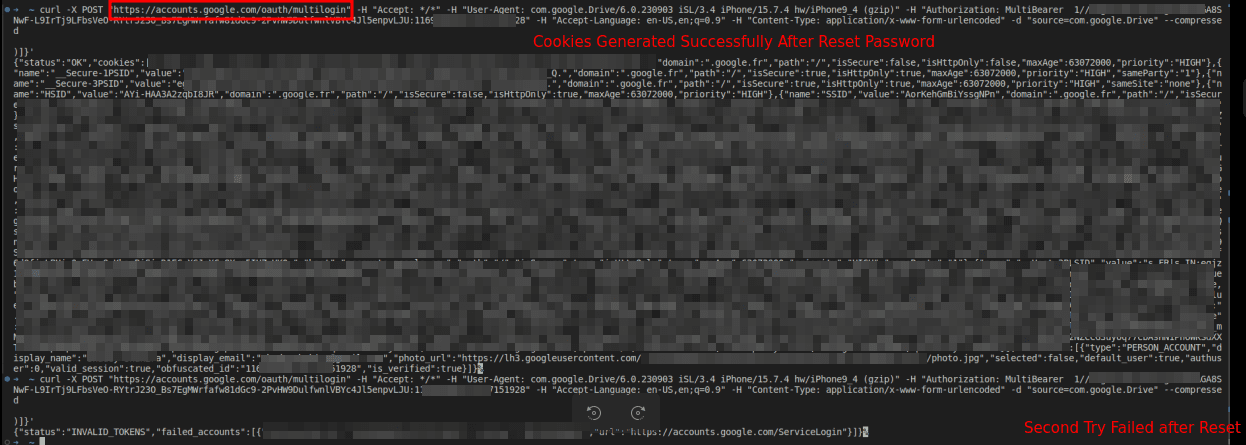
Successful Regeneration of Cookies after Resetting Password

CloudSEK researchers analyzed a zero-day exploit that can allow the generation of persistent Google cookies through token manipulation.

In October 2023, a developer known as PRISMA first uncovered an exploit that allows the generation of persistent Google cookies through token manipulation. An attacker can use the exploit to access Google services, even after a user’s password reset.

Researchers from Hudson Rock were among the first to warn of threat actors exploiting the zero-day exploit:

CloudSEK performed a reverse engineering of the exploit and discovered it relies on an undocumented Google OAuth endpoint named ‘MultiLogin.

The MultiLogin endpoint endpoint is an internal mechanism that allows the synchronization of Google accounts across services.

This endpoint receives a vector containing account IDs and auth-login tokens for efficiently handling concurrent sessions or seamlessly transitioning between user profiles.

The Lumma Infostealer was spotted using the exploit on November 14. Subsequently, other malware integrated the exploit, including Rhadamanthys, Risepro, Meduza, Stealc Stealer and recently the White Snake.

The researchers discovered that the malware targets Chrome’s token_service table of WebData to extract tokens and account IDs of chrome profiles logged in.

“This table contains two crucial columns: service (GAIA ID) and encrypted_token. The encrypted tokens are decrypted using an encryption key stored in Chrome’s Local State within the UserData directory, similar to the encryption used for storing passwords.” reads the report published by CloudSEK.

Google cookies
The structure of the token_service table

The Lumma malware continuously regenerates cookies for Google services by manipulating the token:GAIA ID pair. The experts pointed out that the exploit works even after users have reset their passwords.

“This persistence in access allows for prolonged and potentially unnoticed exploitation of user accounts and data.” continues the report.

Google cookies
Successful Regeneration of Cookies after Resetting Password

“Analysis of the user-agent string found in the source code as seen in  Figure7 (com.google.Drive/6.0.230903 iSL/3.4 iPhone/15.7.4 hw/iPhone9_4 (gzip)) suggests that a penetration test on Google Drive’s services on Apple devices was a potential origin for the exploit. The exploit’s imperfect testing led to revealing its source.” concludes the report.

Google cookies
Figure 7 Reverse Engineered Exploit code which shows endpoint exploited.

At this time, Google has yet to confirm that threat actors are using the zero-day exploit in the MultiLogin endpoint.

Follow me on Twitter: @securityaffairs and Facebook and Mastodon

Pierluigi Paganini

(SecurityAffairs – hacking, Google cookies)