
Europe Confirms Record €4.1B Penalty Against Google for Android Practices|U.S. CISA adds a Microsoft SharePoint Server flaw to its Known Exploited Vulnerabilities catalog|430,000 FortiGate Devices Exposed in FortiBleed Ransomware Link|Adobe fixed multiple maximum-severity flaws in ColdFusion and Campaign Classic|Alleged Scattered Spider Hacker Extradited to U.S. to Face Cybercrime Charges|Oracle E-Business Suite Flaw Under Active Attack, 950 Systems Exposed|Azure CLI Targeted in LSHIY Password Spray Campaign Across 64 Orgs|CISA Warns BlueHammer Flaw Is Now Exploited in Ransomware Attacks|RustDuck: The Botnet That’s Still Small but Engineering Like It Plans to Grow|GuardFall Flaw Hits 10 of 11 Popular Open-Source AI Agents|XSS.is, The Forum That Ran the Ransomware Supply Chain Is Down. The Market Isn’t|U.S. CISA adds SimpleHelp flaw to its Known Exploited Vulnerabilities catalog|Europe Confirms Record €4.1B Penalty Against Google for Android Practices|U.S. CISA adds a Microsoft SharePoint Server flaw to its Known Exploited Vulnerabilities catalog|430,000 FortiGate Devices Exposed in FortiBleed Ransomware Link|Adobe fixed multiple maximum-severity flaws in ColdFusion and Campaign Classic|Alleged Scattered Spider Hacker Extradited to U.S. to Face Cybercrime Charges|Oracle E-Business Suite Flaw Under Active Attack, 950 Systems Exposed|Azure CLI Targeted in LSHIY Password Spray Campaign Across 64 Orgs|CISA Warns BlueHammer Flaw Is Now Exploited in Ransomware Attacks|RustDuck: The Botnet That’s Still Small but Engineering Like It Plans to Grow|GuardFall Flaw Hits 10 of 11 Popular Open-Source AI Agents|XSS.is, The Forum That Ran the Ransomware Supply Chain Is Down. The Market Isn’t|U.S. CISA adds SimpleHelp flaw to its Known Exploited Vulnerabilities catalog|
Advertisement

Ad Placeholder

Full Width × 90

Breaking News

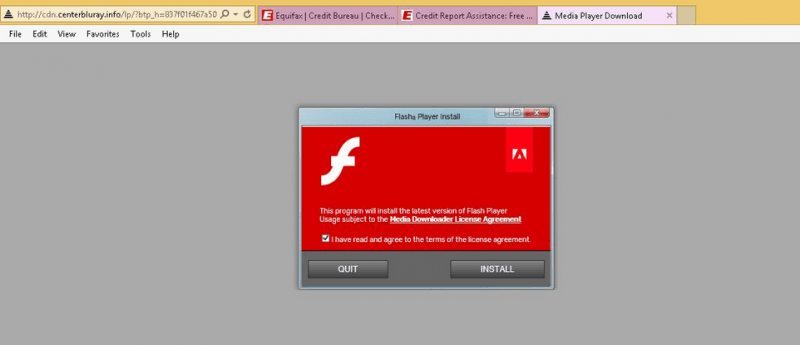
Equifax website redirected visitors to fake Flash update, it’s malvertising

Equifax service set up for obtaining free and discounted credit reports had been redirecting users to websites offering a fake Flash Player installer. The independent security analyst Randy Abrams discovered an Equifax service set up for obtaining free and discounted credit reports had been redirecting users to websites offering a fake Flash Player installer. “As I […]

Equifax Fake_Flash

Equifax service set up for obtaining free and discounted credit reports had been redirecting users to websites offering a fake Flash Player installer.

The independent security analyst Randy Abrams discovered an Equifax service set up for obtaining free and discounted credit reports had been redirecting users to websites offering a fake Flash Player installer.

“As I tried to find my credit report on the Equifax website I clicked on an Equifax link and was redirected to a malicious URL. The URL brought up one of the ubiquitous fake Flash Player Update screens.” Abrams said in a blog post.

Crooks redirected users to the website used to serve adware and scams, the browsing session was taken through multiple domains before the final landing page was reached.

Equifax Fake_Flash


The compromised Equifax webpage (aa.econsumer.equifax.com) was promptly sanitized by the company.

Crooks were redirecting users depending on the type of device and their geographical location, for example, both Android and iOS users were served with fake updates, premium SMS services, and other fraudulent sites.

The company confirmed the problem affected credit report assistance link on its website.

“We are aware of the situation,” a spokesman said. “Our IT and Security teams are looking into this matter, and out of an abundance of caution have temporarily taken this page offline.”

Equifax hack

What’s happened?

It seems that Equifax wasn’t hacked again, but the hack occurred with a third-party ad network or analytics provider which is the root cause of the redirect.

The hypothesis was confirmed by the security researcher Kevin Beaumont that blamed a third-party ad network or analytics provider for the redirects.

https://twitter.com/GossiTheDog/status/918477549671473152

A few days ago, Equifax announced that additional 2.5 million U.S. consumers were exposed as a result of the massive data breach that affected the company in September. The credit reporting agency confirmed that a total of 145.5 million individuals have been exposed, hackers accessed names, social security numbers, dates of birth, addresses and, in some cases, driver’s license numbers and credit card numbers.

[adrotate banner=”9″] [adrotate banner=”12″]

Pierluigi Paganini

(Security Affairs – cybercrime, malvertising)

[adrotate banner=”5″]

[adrotate banner=”13″]


