
Security Affairs
JADEPUFFER: First End-to-End AI-Driven Ransomware Operation|The Anatomy of a Shadow AI Supply-Chain Breach: Lessons from the 2026 Vercel Incident|Law enforcememt operation disrupted Malicious Residential Proxy Networks NetNut|Government and Healthcare Are the Weakest Links in Global Email Security|Europe Confirms Record €4.1B Penalty Against Google for Android Practices|U.S. CISA adds a Microsoft SharePoint Server flaw to its Known Exploited Vulnerabilities catalog|430,000 FortiGate Devices Exposed in FortiBleed Ransomware Link|Adobe fixed multiple maximum-severity flaws in ColdFusion and Campaign Classic|Alleged Scattered Spider Hacker Extradited to U.S. to Face Cybercrime Charges|Oracle E-Business Suite Flaw Under Active Attack, 950 Systems Exposed|Azure CLI Targeted in LSHIY Password Spray Campaign Across 64 Orgs|CISA Warns BlueHammer Flaw Is Now Exploited in Ransomware Attacks|JADEPUFFER: First End-to-End AI-Driven Ransomware Operation|The Anatomy of a Shadow AI Supply-Chain Breach: Lessons from the 2026 Vercel Incident|Law enforcememt operation disrupted Malicious Residential Proxy Networks NetNut|Government and Healthcare Are the Weakest Links in Global Email Security|Europe Confirms Record €4.1B Penalty Against Google for Android Practices|U.S. CISA adds a Microsoft SharePoint Server flaw to its Known Exploited Vulnerabilities catalog|430,000 FortiGate Devices Exposed in FortiBleed Ransomware Link|Adobe fixed multiple maximum-severity flaws in ColdFusion and Campaign Classic|Alleged Scattered Spider Hacker Extradited to U.S. to Face Cybercrime Charges|Oracle E-Business Suite Flaw Under Active Attack, 950 Systems Exposed|Azure CLI Targeted in LSHIY Password Spray Campaign Across 64 Orgs|CISA Warns BlueHammer Flaw Is Now Exploited in Ransomware Attacks|
Advertisement

Ad Placeholder

Full Width × 90

Breaking News

Sonicwall warns of a spike in the number of attacks involving encrypted malware and IoT malware

According to experts at Sonicwall, scanning of random ports and the diffusion of encrypted malware are characterizing the threat landscape. In 2018, global malware volume recorded by SonicWall hit a record-breaking 10.52 billion attacks. The situation is better in the first half of 2019, when SonicWall recorded 4.8 billion attacks, a 20% drop compared to […]

encrypted malware

According to experts at Sonicwall, scanning of random ports and the diffusion of encrypted malware are characterizing the threat landscape.

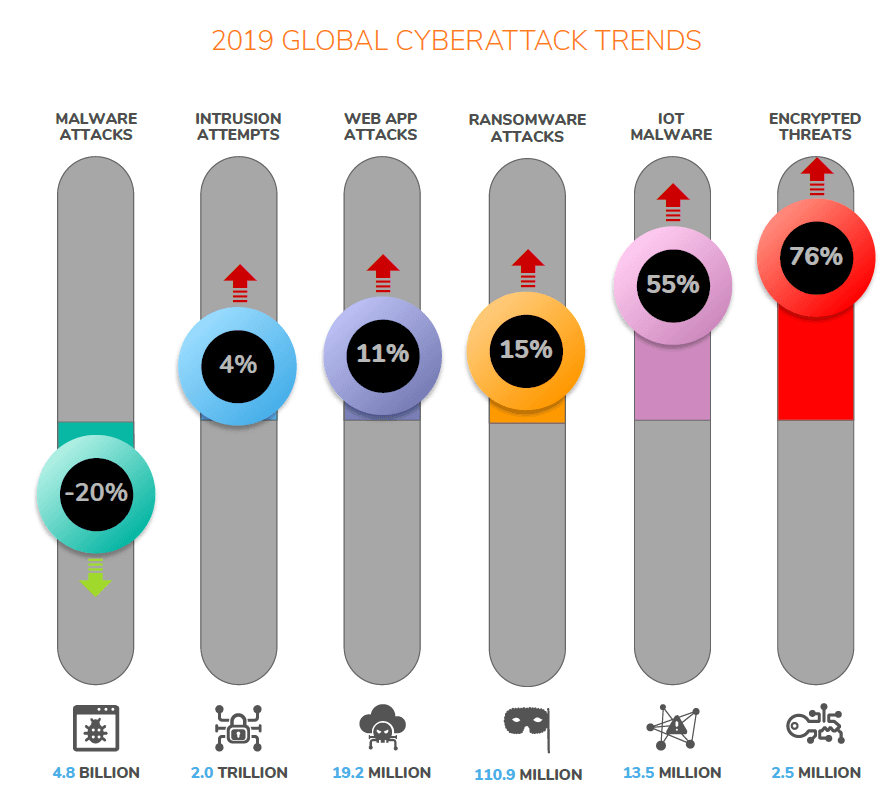
In 2018, global malware volume recorded by SonicWall hit a record-breaking 10.52 billion attacks. The situation is better in the first half of 2019, when SonicWall recorded 4.8 billion attacks, a 20% drop compared to the same time period last year.

Most of the attacks targeted non-standard ports and experts observed a spike in the number of encrypted malware.

“These findings trended across major regions except a few countries: India (25%), Switzerland (72%) and the Netherlands (3%) were the top countries that suffered increased malware activity.” reads the report.
“The United States (-17%) and
United Kingdom (-9%) led the world in the amount of malware attacks faced, but total volume for both were down year to date compared to 2018.”

In 2018 Sonicwall had logged more than 2.8 million encrypted malware attacks, +27% over the previous year. In the first half of 2019, Sonicwall has already monitored 2.4 million encrypted attacks, a 76 percent year-to-date increase that demonstrates the growing trend.

“Through the first six months of 2019, SonicWall has registered 2.4 million encrypted attacks, almost eclipsing the 2018 full-year total in half the time. This marks a 76% year-to-date increase.” continues the report.

The spike in the number of encrypted malware is the result of several factors, such as Ransomware as a Service (RaaS) and open-source malware kits.

Ransomware continues to be a profitable business for the cybercrime ecosystem and the recent wave of attacks against US municipalities demonstrates it.

The report also states that experts observed a spike in the number of cyberattacks against IoT devices carried out by IoT malware.

“In 2017, SonicWall logged just 10.3 million IoT attacks. Last year, that number skyrocketed 215.7% to 32.7 million. In the first half of 2019, SonicWall Capture Labs threat researchers have already recorded 13.5 million IoT attacks, which outpaces the first two quarters of last year by 55%.” states the report. “If the final six months of 2019 match the surge of 2018, it will be another record year for cybercriminals’ use of IoT malware.”

I suggest you read the report that includes other technical details related to the threats monitored by SonicWall.

[adrotate banner=”9″] [adrotate banner=”12″]

Pierluigi Paganini

(SecurityAffairs – encrypted malware, hacking)

[adrotate banner=”5″]

[adrotate banner=”13″]


