
Europe Confirms Record €4.1B Penalty Against Google for Android Practices|U.S. CISA adds a Microsoft SharePoint Server flaw to its Known Exploited Vulnerabilities catalog|430,000 FortiGate Devices Exposed in FortiBleed Ransomware Link|Adobe fixed multiple maximum-severity flaws in ColdFusion and Campaign Classic|Alleged Scattered Spider Hacker Extradited to U.S. to Face Cybercrime Charges|Oracle E-Business Suite Flaw Under Active Attack, 950 Systems Exposed|Azure CLI Targeted in LSHIY Password Spray Campaign Across 64 Orgs|CISA Warns BlueHammer Flaw Is Now Exploited in Ransomware Attacks|RustDuck: The Botnet That’s Still Small but Engineering Like It Plans to Grow|GuardFall Flaw Hits 10 of 11 Popular Open-Source AI Agents|XSS.is, The Forum That Ran the Ransomware Supply Chain Is Down. The Market Isn’t|U.S. CISA adds SimpleHelp flaw to its Known Exploited Vulnerabilities catalog|Europe Confirms Record €4.1B Penalty Against Google for Android Practices|U.S. CISA adds a Microsoft SharePoint Server flaw to its Known Exploited Vulnerabilities catalog|430,000 FortiGate Devices Exposed in FortiBleed Ransomware Link|Adobe fixed multiple maximum-severity flaws in ColdFusion and Campaign Classic|Alleged Scattered Spider Hacker Extradited to U.S. to Face Cybercrime Charges|Oracle E-Business Suite Flaw Under Active Attack, 950 Systems Exposed|Azure CLI Targeted in LSHIY Password Spray Campaign Across 64 Orgs|CISA Warns BlueHammer Flaw Is Now Exploited in Ransomware Attacks|RustDuck: The Botnet That’s Still Small but Engineering Like It Plans to Grow|GuardFall Flaw Hits 10 of 11 Popular Open-Source AI Agents|XSS.is, The Forum That Ran the Ransomware Supply Chain Is Down. The Market Isn’t|U.S. CISA adds SimpleHelp flaw to its Known Exploited Vulnerabilities catalog|
Advertisement

Ad Placeholder

Full Width × 90

Breaking News

Electronic Frontier Foundation – WhatsApp ranked as the worst at protecting users’ privacy

The Electronic Frontier Foundation published the “Who Has Your Back? 2015” report that ranked WhatsApp ranked as the worst in protecting users’ privacy. The Electronic Frontier Foundation has published its annual report “Who Has Your Back? 2015: Protecting Your Data From Government Requests” that analyzes how private companies handlesusers data with specific focus on Government surveillance. “Which […]

Electronic Frontier Foundation – WhatsApp ranked as the worst at protecting users’ privacy

The Electronic Frontier Foundation published the “Who Has Your Back? 2015” report that ranked WhatsApp ranked as the worst in protecting users’ privacy.

The Electronic Frontier Foundation has published its annual report “Who Has Your Back? 2015: Protecting Your Data From Government Requests” that analyzes how private companies handlesusers data with specific focus on Government surveillance.

“Which companies will stand by users, insisting on transparency and strong legal standards around government access to user data? And which companies make those policies public, letting the world—and their own users—judge their stances on standing up for privacy rights?

For four years, the Electronic Frontier Foundation documented the practices of major Internet companies and service providers, judging their publicly available policies, and highlighting best practices.” states the Electronic Frontier Foundation Report.

This major findings of the report are:

Major Findings in the 2015 Electronic Frontier Foundation Report:

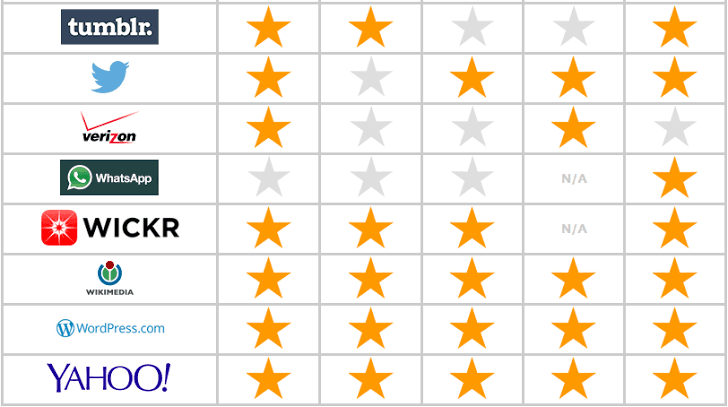
  • Nine Companies Receive All Available Stars: Adobe, Apple, CREDO, Dropbox, Sonic, Wickr, Wikimedia, WordPress.com, and Yahoo
  • AT&T, Verizon, and WhatsApp Lag Behind Industry in Standing by Users
  • Overwhelming Majority of Tech Companies Oppose Government-Mandated Backdoors
AT&T, Verizon and WhatsApp came out to be the worst companies in protecting its users’ data.
It is shocking to read that one of the most popular applications, WhatsApp, is considered by the experts as one of the three worst companies in protecting its users’ data representing a serious threat for the privacy.

Which is the judgment criteria adopted by the EFF?

The analysis is based on the following five criteria:
  • Follows Industry Accepted Best Practices
  • Tells Users About Government Data Demands
  • Discloses Policies on Data Retention
  • Discloses Government Content Removal Requests
  • Pro-user Public Policy: opposes backdoors

According to the experts Verizon met only two of the EFF’s criteria used for the evaluation, meanwhile WhatsApp and AT&T only met one. The companies fail in protecting the privacy of their users when receive government requests.

The company Adobe, Apple, CREDO, Dropbox, Sonic, Wickr, Wikimedia, WordPress.com, and Yahoo obtained the maximum number of starts demonstrating a great attention in both security and privacy of their users.

“We appreciate the steps that WhatsApp’s parent company Facebook has taken to stand by its users, but there is room for WhatsApp to improve. WhatsApp should publicly require a warrant before turning over user content, publish a law enforcement guide and transparency report, have a stronger policy of informing users of government requests, and disclose its data retention policies. WhatsApp does get credit for Facebook’s public position opposing back doors, and we commend Facebook for that.” states the post referring WhatsApp.

As reported in the following table the giants Amazon, Google and Microsoft obtained only three stars each, a rate considered disappointing by the privacy defenders and advocates.

However, the EFF report also says that Microsoft has made improvement in company practices and will be in a position to raise a fourth star in September.

Electronic Frontier Foundation report 1

Electronic Frontier Foundation report 2

Electronic Frontier Foundation report 3

I invite you to read the Electronic Frontier Foundation report and I desire to close with a statement reported in the analysis:“But times have changed, and now users expect more.”

Let’s hope companies will do even more to protect the privacy of their users.

Pierluigi Paganini

(Security Affairs – Electronic Frontier Foundation, privacy)


