
Malware researchers from Abuse.ch, BrillantIT, and Proofpoint have sinkholed the control infrastructure behind EITest campaign and shut down it.
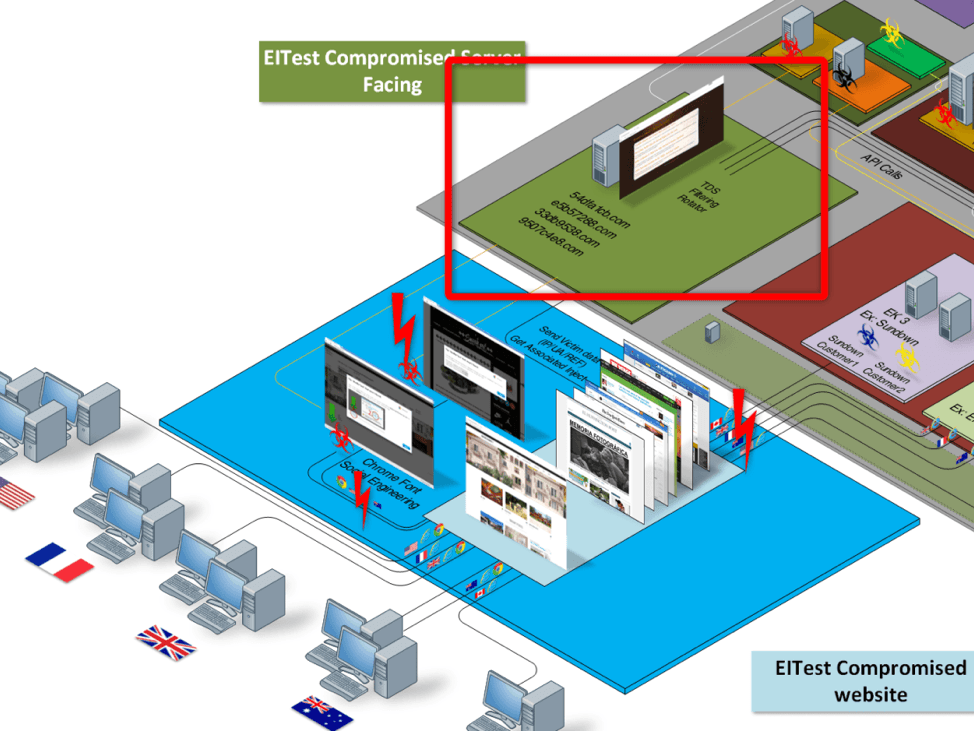
Malware researchers from Abuse.ch, BrillantIT, and Proofpoint have sinkholed the control infrastructure behind EITest campaign that leveraged on a network of hacked servers exploited by crooks to distribute traffic (TDS).
The network was used to redirect users to compromised domains hosting exploit kits, delivering malware or used for other fraudulent activities such as tech scams.
EITest infrastructure was first discovered back in 2011, from middle 2014 crooks started using it as a TDS botnet.
“researchers traced the chain via server side artifacts and some historical analysis of server side compromises to infections as early as 2011 when it was redirecting to a private EK known as Glazunov.” wrote Proofpoint researcher Kafeine.
“The infection chain appears to have paused between the end of 2013 and the beginning of July 2014, when it began directing into Angler“
Hackers installed a backdoor on the compromised machines and used it to redirect legitimate traffic to malicious websites, for this reason, experts defined EITest as the “king of traffic distribution.”
“EITest is one of the longest malicious delivery campaigns that has continued to evolve. In the spring of 2017, it started redirecting Internet Explorer users to tech support scams in addition to the existing redirections with the fake Chrome fonts.” reads the analysis published “Malware don’t need coffee.” website.
“Actors behind this campaign are generating hundreds of domains per day.The only purpose of those domains names is to redirect users to tech support scams or malicious websites.”
According to researcher Kafeine, crooks behind the EITest campaign started selling hijacked traffic from hacked sites for $20 per 1,000 users, selling traffic blocks of 50-70,000 visitors, generating between $1,000 and $1,400 per block of traffic.
“in the past month the activity behind this infection chain has primarily consisted of social engineering [1] and tech support scams [3] leading to ransomware.” added Kafeine.
Early 2018, a malware a researcher at BrillantIT was able to sinkhole the botnet after discovered how to crack the way the bots contact the C&C servers.

The experts were able to hijack the entire EITest network by seizing just one domain (stat-dns.com) Traffic analysis allowed the researchers to discover that the botnet handled about two million users per day coming from over 52,000 compromised websites, most of which were WordPress sites.
Kafeine added that following the successful sinkhole operation, the operators behind the botnet have shut down their C&C proxies. Kafeine added the experts noticed some encoded calls to the sinkhole that embedded commands they would associate with takeover attempts. At the time it is not clear who sent them, likely the operators or other researchers attempting to interact control infrastructure.
“Following the successful sinkhole operation, the actor shut down their C&C proxies, but we have not observed further overt reactions by the operators of EITest,” concluded Kafeine.
“However, we will continue to monitor EITest activity as the EITest actor may attempt to regain control of a portion of the compromised websites involved in the infection chain.”
| [adrotate banner=”9″] | [adrotate banner=”12″] |
(Security Affairs – EITest network, hacking)
[adrotate banner=”5″]
[adrotate banner=”13″]


