
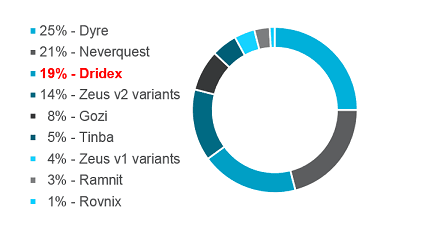
Security experts at IBM X-Force team discovered a new hacking campaign based on the infamous Dridex trojan.
The Dridex banking trojan is considered one of the most serious threats to banks, in October 2015, security experts at Palo Alto intelligence discovered a still ongoing large phishing campaign targeting victims mainly in the UK.

A detailed analysis of the redirection mechanism allowed X-Force researchers to link the new Dridex infection to the Dyre Trojan’s redirection attack scheme, the unique difference in redirection mechanism is that while Dyre redirects via a local proxy, the Dridex redirects via local DNS poisoning.
“X-Force researchers studied the attacks linked with the new Dridex infection campaigns and learned that the malware’s operators have made considerable investments in a new attack methodology. The new scheme is not entirely novel; it copies the concept of the Dyre Trojan’s redirection attack scheme. The difference between Dyre and Dridex is the way in which the redirection takes place: Dyre redirects via a local proxy, while Dridex redirects via local DNS poisoning.” states the post.
By implementing this attack scheme, the attackers aim to deceive victims into divulging authentication codes,
“When Dyre started using this scheme, it was targeting over a dozen banks; a rather resource-intensive operation that eventually drove Dyre’s operators to switch back to using web injections and page replacements.”
According to the experts, Dridex operators are scaling up on quantity and quality, the number of banks targeted by the cyber criminals behind this threat is increasing and the code is even more sophisticated and continuously updated.
“Dridex also continues to scale up in victim quality. The bank URLs on the target list are, for the most part, the dedicated subdomains for business and corporate account access. By targeting the higher-value customers in each bank, Dridex’s operators are clearly planning to make large fraudulent transfers out of business accounts and are less enticed by personal banking.”
(Security Affairs – Dridex Trojan, cybercrime)


