
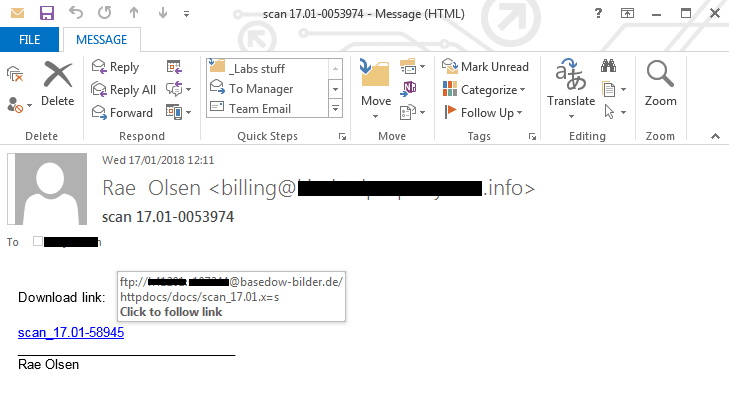
Security researchers at Forcepoint have spotted a new spam campaign that is abusing compromised FTP servers as a repository for malicious documents and infecting users with the Dridex banking Trojan.
The Dridex banking Trojan is a long-running malware that has been continuously improved across the years.
The malicious email campaign was first noticed by Forcepoint on January 17, 2018, the messages were primarily sent to .com top level domains (TDLs) most of them in France, the UK, and Australia.

“The sender domains used are observed to be compromised accounts. The sender names rotated around the following names, perhaps to make the emails look more convincing to unsuspecting recipients: admin@, billing@, help@, info@, mail@, no-reply@, sale@, support@, ticket@.” reads the analysis published by Forcepoint.
Attackers used at least two types of weaponized documents, one of them is a Word document abusing DDE protocol for malware execution, and an XLS file with macro code that download the Dridex banking Trojan from a compromised server.

According to the experts, the attackers obtained in some way the login credentials to compromise the servers used in this campaign.
“The compromised servers do not appear to be running the same FTP software; as such, it seems likely that the credentials were compromised in some other way.” states Forcepoint.
“The perpetrators of the campaign do not appear to be worried about exposing the credentials of the FTP sites they abuse, potentially exposing the already-compromised sites to further abuse by other groups. This may suggest that the attackers have an abundant supply of compromised accounts and therefore view these assets as disposable,”
The experts believe the campaign is leveraging the infamous Necurs botnet to send out spam messages, researchers noticed that downloaders used by attackers are similar to those used by the botnet before.
Forcepoint highlighted that the spam volume associated with this campaign was very low compared to other Necurs campaigns, attackers sent only 9,500 emails, it is very low respect millions of emails sent through the botnet in other campaigns.
Another peculiarity of this campaign is the use of FTP servers for download the malware.
“Cybercriminals constantly update their attack methods to try and ensure maximum infection rates. In this case FTP sites were used, perhaps in an attempt to prevent being detected by email gateways and network policies that may consider FTPs as trusted locations. The presence of FTP credentials in the emails highlights the importance of regularly updating passwords,” Forcepoint concluded.
Forcepoint report included IoCs for this campaign.
| [adrotate banner=”9″] | [adrotate banner=”12″] |
(Security Affairs – botnet, Dridex banking Trojan)
[adrotate banner=”5″]
[adrotate banner=”13″]


