
U.S. CISA adds a Microsoft SharePoint Server flaw to its Known Exploited Vulnerabilities catalog|430,000 FortiGate Devices Exposed in FortiBleed Ransomware Link|Adobe fixed multiple maximum-severity flaws in ColdFusion and Campaign Classic|Alleged Scattered Spider Hacker Extradited to U.S. to Face Cybercrime Charges|Oracle E-Business Suite Flaw Under Active Attack, 950 Systems Exposed|Azure CLI Targeted in LSHIY Password Spray Campaign Across 64 Orgs|CISA Warns BlueHammer Flaw Is Now Exploited in Ransomware Attacks|RustDuck: The Botnet That’s Still Small but Engineering Like It Plans to Grow|GuardFall Flaw Hits 10 of 11 Popular Open-Source AI Agents|XSS.is, The Forum That Ran the Ransomware Supply Chain Is Down. The Market Isn’t|U.S. CISA adds SimpleHelp flaw to its Known Exploited Vulnerabilities catalog|Hackers Steal Data of 4.38 Million Aflac Japan Customers|U.S. CISA adds a Microsoft SharePoint Server flaw to its Known Exploited Vulnerabilities catalog|430,000 FortiGate Devices Exposed in FortiBleed Ransomware Link|Adobe fixed multiple maximum-severity flaws in ColdFusion and Campaign Classic|Alleged Scattered Spider Hacker Extradited to U.S. to Face Cybercrime Charges|Oracle E-Business Suite Flaw Under Active Attack, 950 Systems Exposed|Azure CLI Targeted in LSHIY Password Spray Campaign Across 64 Orgs|CISA Warns BlueHammer Flaw Is Now Exploited in Ransomware Attacks|RustDuck: The Botnet That’s Still Small but Engineering Like It Plans to Grow|GuardFall Flaw Hits 10 of 11 Popular Open-Source AI Agents|XSS.is, The Forum That Ran the Ransomware Supply Chain Is Down. The Market Isn’t|U.S. CISA adds SimpleHelp flaw to its Known Exploited Vulnerabilities catalog|Hackers Steal Data of 4.38 Million Aflac Japan Customers|
Advertisement

Ad Placeholder

Full Width × 90

Breaking News

DNS hijacking campaigns target Gmail, Netflix, and PayPal users

Security experts at Bad Packets uncovered a DNS hijacking campaign that is targeting the users of popular online services, including Gmail, Netflix, and PayPal. Experts at Bad Packets uncovered a DNS hijacking campaign that has been ongoing for the past three months, attackers are targeting the users of popular online services, including Gmail, Netflix, and […]

DNS hijacking compromised_d-link

Security experts at Bad Packets uncovered a DNS hijacking campaign that is targeting the users of popular online services, including Gmail, Netflix, and PayPal.

Experts at Bad Packets uncovered a DNS hijacking campaign that has been ongoing for the past three months, attackers are targeting the users of popular online services, including Gmail, Netflix, and PayPal.

Hackers compromised consumer routers and modified the DNS settings to redirect users to fake websites designed to trick victims into providing their login credentials.

Bad Packets experts have identified four rogue DNS servers being used by attackers to hijack user traffic.

“Over the last three months, our honeypots have detected DNS hijacking attacks targeting various types of consumer routers.” reads the report published by Bad Packets. “All exploit attempts have originated from hosts on the network of Google Cloud Platform (AS15169). In this campaign, we’ve identified four distinct rogue DNS servers being used to redirect web traffic for malicious purposes.”

Experts pointed out that all exploit attempts have originated from hosts on the network of Google Cloud Platform (AS15169).

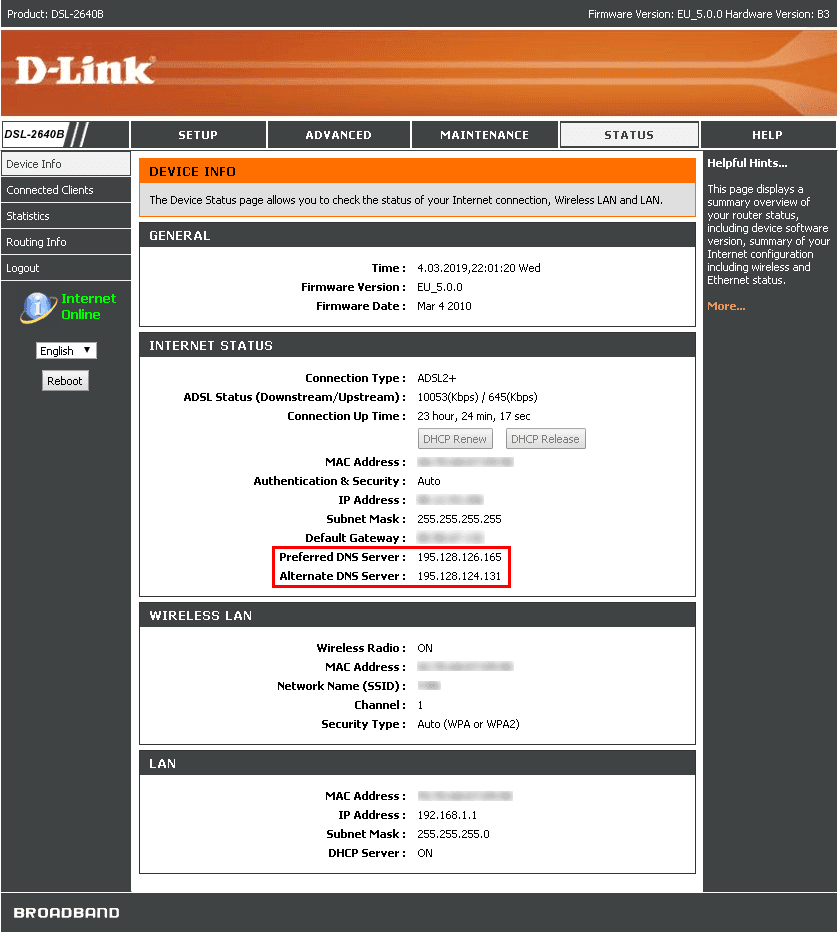
The first wave of DNS hijacking attacks targeted D-Link DSL modems, including D-Link DSL-2640B, DSL-2740R, DSL-2780B, and DSL-526B. The DNS server used in this attack was hosted by OVH Canada (66[.]70.173.48).

https://twitter.com/bad_packets/status/1079251375987425280

The second wave of attacks targeted the same D-Link modems, but attackers used a different rogue DNS server (144[.]217.191.145) hosted by OVH Canada.

DNS hijacking compromised_d-link

“As Twitter user “parseword” noted, the majority of the DNS requests were being redirected to two IPs allocated to a crime-friendly hosting provider (AS206349) and another pointing to a service that monetizes parked domain names (AS395082).” continues the experts.

The third wave of attacks observed in March hit a larger number of router models, including ARG-W4 ADSL routers, DSLink 260E routers, Secutech routers, and TOTOLINK routers.

https://twitter.com/bad_packets/status/1112087547050520577

The fourth DNS hijacking attacks originated from three distinct Google Cloud Platform hosts and involved two rogue DNS servers hosted in Russia by Inoventica Services (195[.]128.126.165 and 195[.]128.124.131).

In all the DNS hijacking attacks the operators performed an initial recon scan using Masscan. Attackers check for active hosts on port 81/TCP before launching the DNS hijacking exploits.

The campaigns aim at users Gmail, PayPal, Netflix, Uber, attackers also hit several Brazilian banks. , says

Experts found over 16,500 vulnerable routers potentially exposed to this DNS hijacking campaign.

“Establishing a definitive total of vulnerable devices would require us to employ the same tactics used by the threat actors in this campaign. Obviously this won’t be done, however we can catalog how many are exposing at least one service to the public internet via data provided by BinaryEdge” continues Bad Packets.

Experts explained that attackers abused Google’s Cloud platform for these attacks because it is easy for everyone with a Google account to access a “Google Cloud Shell.” This service offers users the equivalent of a Linux VPS with root privileges directly in a web browser.

Further technical details, including IoCs, are reported in the analysis published by Bad Packets:

https://badpackets.net/ongoing-dns-hijacking-campaign-targeting-consumer-routers/

[adrotate banner=”9″] [adrotate banner=”12″]

Pierluigi Paganini

(SecurityAffairs – DNS hijacking, hacking)

[adrotate banner=”5″]

[adrotate banner=”13″]


