
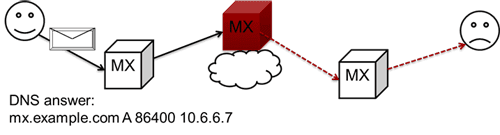
CERT warns that DNS Cache Poisoning attacks could be used also to hijack email to a rogue server and not only to divert the Internet traffic.
DNS attacks are very popular in hacking community, they could be run by cyber criminals and state-sponsored hackers for various purposes, including cyber espionage and financially motivated attacks.
A DNS is a critical component in a network because it is responsible for the translation of logical names into IP addresses, but an attacker could hit DNS servers to force to return an incorrect IP address and divert traffic to another computer managed by bad actors.
Recently we have assisted different cases of DNS spoofing or cache poisoning attacks, in which hackers redirect the traffic of a legitimate website to a bogus one with serious consequences.
But DNS is also a crucial component for many other Internet protocols, including email that use DNS responses to determine the final recipient of the email.
Virus Bulletin has recently published an interesting post on DNS poisoning attacks used to steal users’ emails in which the experts explained the role of DNS in mailing systems:
“When an email is sent over the Internet, the sender’s mail server needs to find the recipient’s mail server. This takes two DNS lookups: first, the MX record for the recipient’s domain is requested, which returns one or more domains of the inbound mail server. The A record of one of these domains is then requested to find the corresponding IP address.” states the post from Virus Bulletin.

A threat actor could interfere with the above process, in particular manipulating one of the two responses, can hijack the mail to its server.
Recently CERT/CC researchers Jonathan Spring and Leigh Metcalf have provided the evidence that such attacks are ordinarily conducted by hackers. The researchers have analyzed DNS responses for A records belonging to mail servers of the principal providers, including Gmail, Yahoo! and Hotmail.
“Using our passive DNS data source, we can observe cache poisoning. What we really observe are changes in the answers that are returned for certain domains, but after consulting with various experts, we believe the only behavior these changes indicate is a successful cache poisoning attack.”
How to prevent this kind of attacks?
The CERT/CC researchers mentioned two solutions to prevent this kind of attacks, one at the user side and the other at the server side.
- At the user level, one should use end-to-end encryption using PGP or S/MIME, of course this solution can only protect the content of the email, but not the routing process.
- At the server level, it is possible to adopt the DNSSEC, a mechanism to guarantee the integrity of the DNS responses the issue should be solved by DNSSEC, which guarantees the integrity of the DNS responses, unfortunately only a limited number of domains currently deploy DNSSEC.
In the graphic below it is possible to note that only around 0.5% of the .com and .net domains currently support DNSSEC.

The experts at CERT highlighted that they ignore the motivation of the attacks neither the threat actors behind them, in the blog post published they also provides the list of the IP addresses involved in the attacks.
(Security Affairs – DNS attacks, email)


