Security Affairs
Claude Code and DeepSeek Powered Chinese Cyber Espionage Campaign|Zoom Fixes CVE-2026-53412, a Critical Account Takeover Bug|US and allied Governments’ Recommendations: Securing Network Devices Against Russian APT Groups|Chaotic Eclipse Unveils LegacyHive Exploit Affecting Fully Patched Windows Systems|AsyncAPI npm Supply Chain Attack: Malware Injected Into Packages With 2 Million Weekly Downloads|U.S. CISA adds SonicWall and Microsoft flaws to its Known Exploited Vulnerabilities catalog|SonicWall warns of active exploitation of two SMA 1000 zero-days|Patch Tuesday security updates for July 2026, the largest update ever. 621 CVEs in one month|U.S. Treasury Sanctions VPN Provider and Cryptor Seller Behind Billions in Ransomware Losses|Attacker Used AI to Build Custom PowerShell Recon Malware|Malware Hits Japan’s Largest Taxi Company Nihon Kotsu, Services Temporarily Suspended|CrashStealer: New macOS Infostealer Uses Signed Apps to Evade Gatekeeper|Claude Code and DeepSeek Powered Chinese Cyber Espionage Campaign|Zoom Fixes CVE-2026-53412, a Critical Account Takeover Bug|US and allied Governments’ Recommendations: Securing Network Devices Against Russian APT Groups|Chaotic Eclipse Unveils LegacyHive Exploit Affecting Fully Patched Windows Systems|AsyncAPI npm Supply Chain Attack: Malware Injected Into Packages With 2 Million Weekly Downloads|U.S. CISA adds SonicWall and Microsoft flaws to its Known Exploited Vulnerabilities catalog|SonicWall warns of active exploitation of two SMA 1000 zero-days|Patch Tuesday security updates for July 2026, the largest update ever. 621 CVEs in one month|U.S. Treasury Sanctions VPN Provider and Cryptor Seller Behind Billions in Ransomware Losses|Attacker Used AI to Build Custom PowerShell Recon Malware|Malware Hits Japan’s Largest Taxi Company Nihon Kotsu, Services Temporarily Suspended|CrashStealer: New macOS Infostealer Uses Signed Apps to Evade Gatekeeper|
Advertisement

Ad Placeholder

Full Width × 90

Breaking News

The new Dirty COW Linux Kernel Exploit already used in attacks in the wild

Experts disclosed a new Linux kernel vulnerability dubbed Dirty COW that could be exploited by an unprivileged local attacker to escalate privileges. The security expert Phil Oester discovered in the Linux kernel a new flaw, dubbed ‘Dirty COW‘ that could be exploited by a local attacker to escalate privileges. The name “Dirty COW” is due to the […]

Dirty Cow

Experts disclosed a new Linux kernel vulnerability dubbed Dirty COW that could be exploited by an unprivileged local attacker to escalate privileges.

The security expert Phil Oester discovered in the Linux kernel a new flaw, dubbed ‘Dirty COW‘ that could be exploited by a local attacker to escalate privileges.

The name “Dirty COW” is due to the fact that it’s triggered by a race condition in the way the Linux kernel’s memory subsystem handles copy-on-write (COW) breakage of private read-only memory mappings.

According to the security advisory published by Red Had, the vulnerability, tracked as CVE-2016-5195, allows local attackers to modify existing setuid files.

“A race condition was found in the way the Linux kernel’s memory subsystem handled the copy-on-write (COW) breakage of private read-only memory mappings. An unprivileged local user could use this flaw to gain write access to otherwise read-only memory mappings and thus increase their privileges on the system.” states the Red Had security advisory.

“This could be abused by an attacker to modify existing setuid files with instructions to elevate privileges. An exploit using this technique has been found in the wild.”

Dirty COW exploit

Red Hat also confirmed that attackers are using an exploit leveraging the Dirty COW in the wild.

The good news is that a solution to the issue is already available and Linux distributions have started releasing updates.

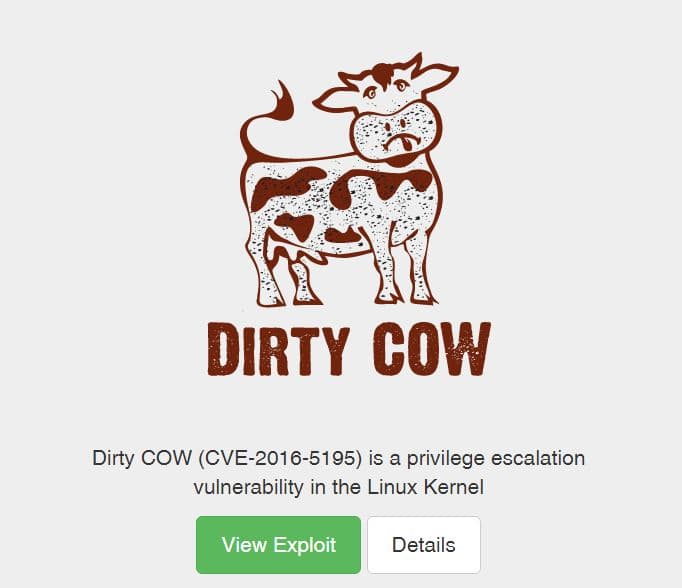
There is also a curious aspect of the Dirty COW, researchers that discovered it launched a sort of marketing operation around the issue, created a website, a logo and a Twitter account. They are also running a shop that sells “Dirty COW” mugs and t-shirts.

Let me close with one of the questions in the FAQ session of the website:

Can my antivirus detect or block this attack?

“Although the attack can happen in different layers, antivirus signatures that detect Dirty COW could be developed. Due to the attack complexity, differentiating between legitimate use and attack cannot be done easily, but the attack may be detected by comparing the size of the binary against the size of the original binary. This implies that antivirus can be programmed to detect the attack but not to block it unless binaries are blocked altogether.”

The researchers also published the exploit code on GitHub.

[adrotate banner=”9″] [adrotate banner=”12″]

Pierluigi Paganini

(Security Affairs – Linux, hacking)

[adrotate banner=”5″]

[adrotate banner=”13″]