
Europe Confirms Record €4.1B Penalty Against Google for Android Practices|U.S. CISA adds a Microsoft SharePoint Server flaw to its Known Exploited Vulnerabilities catalog|430,000 FortiGate Devices Exposed in FortiBleed Ransomware Link|Adobe fixed multiple maximum-severity flaws in ColdFusion and Campaign Classic|Alleged Scattered Spider Hacker Extradited to U.S. to Face Cybercrime Charges|Oracle E-Business Suite Flaw Under Active Attack, 950 Systems Exposed|Azure CLI Targeted in LSHIY Password Spray Campaign Across 64 Orgs|CISA Warns BlueHammer Flaw Is Now Exploited in Ransomware Attacks|RustDuck: The Botnet That’s Still Small but Engineering Like It Plans to Grow|GuardFall Flaw Hits 10 of 11 Popular Open-Source AI Agents|XSS.is, The Forum That Ran the Ransomware Supply Chain Is Down. The Market Isn’t|U.S. CISA adds SimpleHelp flaw to its Known Exploited Vulnerabilities catalog|Europe Confirms Record €4.1B Penalty Against Google for Android Practices|U.S. CISA adds a Microsoft SharePoint Server flaw to its Known Exploited Vulnerabilities catalog|430,000 FortiGate Devices Exposed in FortiBleed Ransomware Link|Adobe fixed multiple maximum-severity flaws in ColdFusion and Campaign Classic|Alleged Scattered Spider Hacker Extradited to U.S. to Face Cybercrime Charges|Oracle E-Business Suite Flaw Under Active Attack, 950 Systems Exposed|Azure CLI Targeted in LSHIY Password Spray Campaign Across 64 Orgs|CISA Warns BlueHammer Flaw Is Now Exploited in Ransomware Attacks|RustDuck: The Botnet That’s Still Small but Engineering Like It Plans to Grow|GuardFall Flaw Hits 10 of 11 Popular Open-Source AI Agents|XSS.is, The Forum That Ran the Ransomware Supply Chain Is Down. The Market Isn’t|U.S. CISA adds SimpleHelp flaw to its Known Exploited Vulnerabilities catalog|
Advertisement

Ad Placeholder

Full Width × 90

Breaking News

DeepLocker – AI-powered malware are already among us

Security researchers at IBM Research developed a “highly targeted and evasive” AI-powered malware dubbed DeepLocker and will present today. What about Artificial Intelligence (AI) applied in malware development? Threat actors can use AI-powered malware to create powerful malicious codes that can evade sophisticated defenses. Security researchers at IBM Research developed a “highly targeted and evasive” attack tool powered […]

deeplocker chart

Security researchers at IBM Research developed a “highly targeted and evasive” AI-powered malware dubbed DeepLocker and will present today.

What about Artificial Intelligence (AI) applied in malware development? Threat actors can use AI-powered malware to create powerful malicious codes that can evade sophisticated defenses.

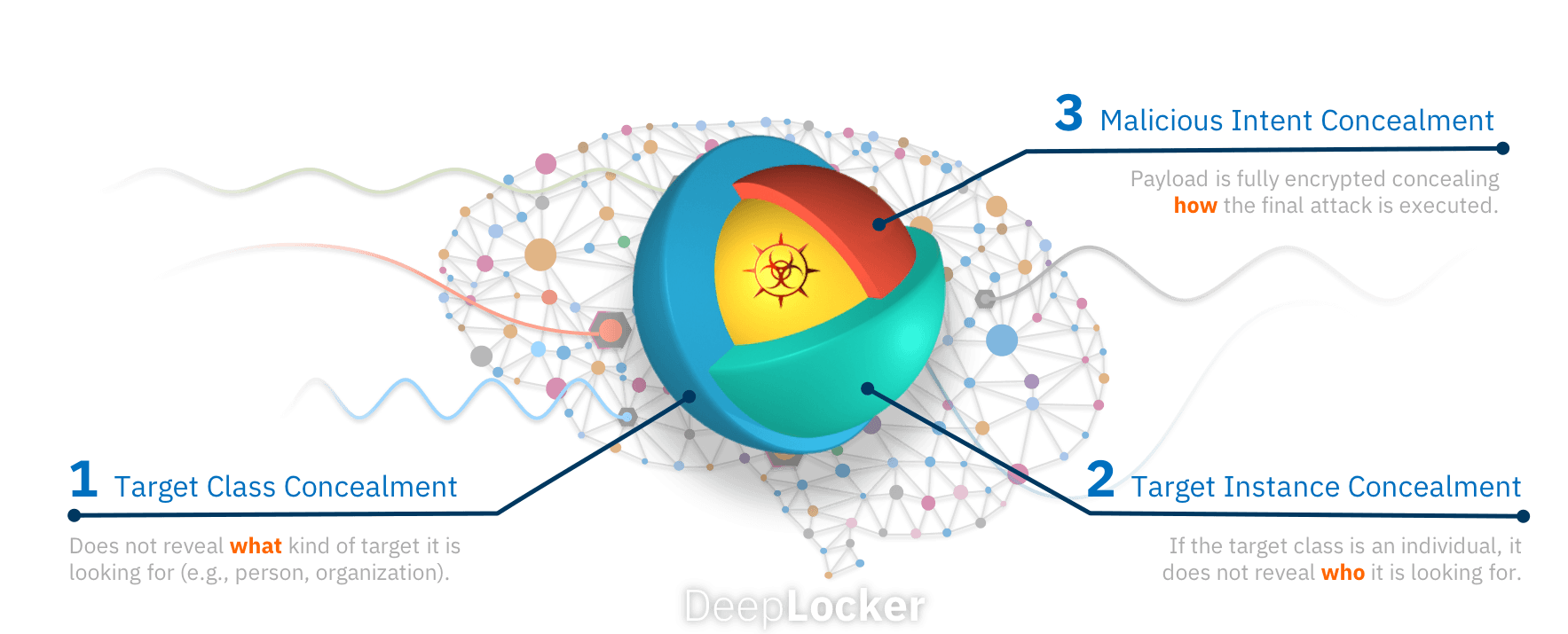
Security researchers at IBM Research developed a “highly targeted and evasive” attack tool powered by AI,” dubbed DeepLocker that is able to conceal its malicious intent until it has infected the specific target.

“IBM Research developed DeepLocker to better understand how several existing AI models can be combined with current malware techniques to create a particularly challenging new breed of malware.” reads a blog post published by the experts.

“This class of AI-powered evasive malware conceals its intent until it reaches a specific victim. It unleashes its malicious action as soon as the AI model identifies the target through indicators like facial recognition, geolocation and voice recognition.” 

According to the IBM researcher, DeepLocker is able to avoid detection and activate itself only after specific conditions are matched.
AI-powered malware represents a privileged optional in high-targeted attacks like the ones carried out by nation-state actors.
The malicious code could be concealed in harmful applications and select the target based on various indicators such as voice recognition, facial recognition, geolocation and other system-level features.

“DeepLocker hides its malicious payload in benign carrier applications, such as a video conference software, to avoid detection by most antivirus and malware scanners.” continues IBM.

“What is unique about DeepLocker is that the use of AI makes the “trigger conditions” to unlock the attack almost impossible to reverse engineer. The malicious payload will only be unlocked if the intended target is reached. It achieves this by using a deep neural network (DNN) AI model.”

deeplocker chart

The researchers shared a proof of concept by hiding the WannaCry ransomware in a video conferencing app and keeping it stealth until the victim is identified through the facial recognition. Experts pointed out that the target can be identified by matching his face with publicly available photos.

“To demonstrate the implications of DeepLocker’s capabilities, we designed a proof of concept in which we camouflage a well-known ransomware (WannaCry) in a benign video conferencing application so that it remains undetected by malware analysis tools, including antivirus engines and malware sandboxes. As a triggering condition, we trained the AI model to recognize the face of a specific person to unlock the ransomware and execute on the system.”

“Imagine that this video conferencing application is distributed and downloaded by millions of people, which is a plausible scenario nowadays on many public platforms. When launched, the app would surreptitiously feed camera snapshots into the embedded AI model, but otherwise behave normally for all users except the intended target,” the researchers added.

“When the victim sits in front of the computer and uses the application, the camera would feed their face to the app, and the malicious payload will be secretly executed, thanks to the victim’s face, which was the preprogrammed key to unlock it.”

The IBM Research group will provider further details today more details in a live demo at the Black Hat USA security conference in Las Vegas.

[adrotate banner=”9″] [adrotate banner=”12″]

Pierluigi Paganini

(Security Affairs – AI-powered malware, DeepLocker )

[adrotate banner=”5″]

[adrotate banner=”13″]


