
Researchers at Qihoo 360’s Netlab analyzed a new campaign powered by the DDG botnet, the second largest mining botnet of ever, that targets Redis and OrientDB servers.
A new Monero-mining botnet dubbed DDG was spotted in the wild, the malware targets Redis and OrientDB servers.
According to the researchers at Qihoo 360’s Netlab, the DDG botnet was first detected in 2016 and is continuously updated throughout 2017.
“Starting 2017-10-25, we noticed there was a large scale ongoing scan targeting the OrientDB databases. Further analysis found that this is a long-running botnet whose main goal is to mine Monero CryptoCurrency. We name it DDG.Mining.Botnet after its core function module name DDG.” reads the analysis published by Netlab.
The miner has already infected nearly 4,400 servers and has mined over $925,000 worth of Monero since March 2017, DDG is among the largest mining botnets.
Yesterday I wrote about the greatest mining botnet called Smominru that has infected over 526,000 Windows machines, its operators had already mined approximately 8,900 Monero ($2,346,271 at the current rate).
The malware exploits the remote code execution vulnerability CVE-2017-11467 to compromise OrientDB databases and targets Redis servers via a brute-force attack.
Crooks are focusing their efforts on attacks against servers that usually have significant computing capabilities.
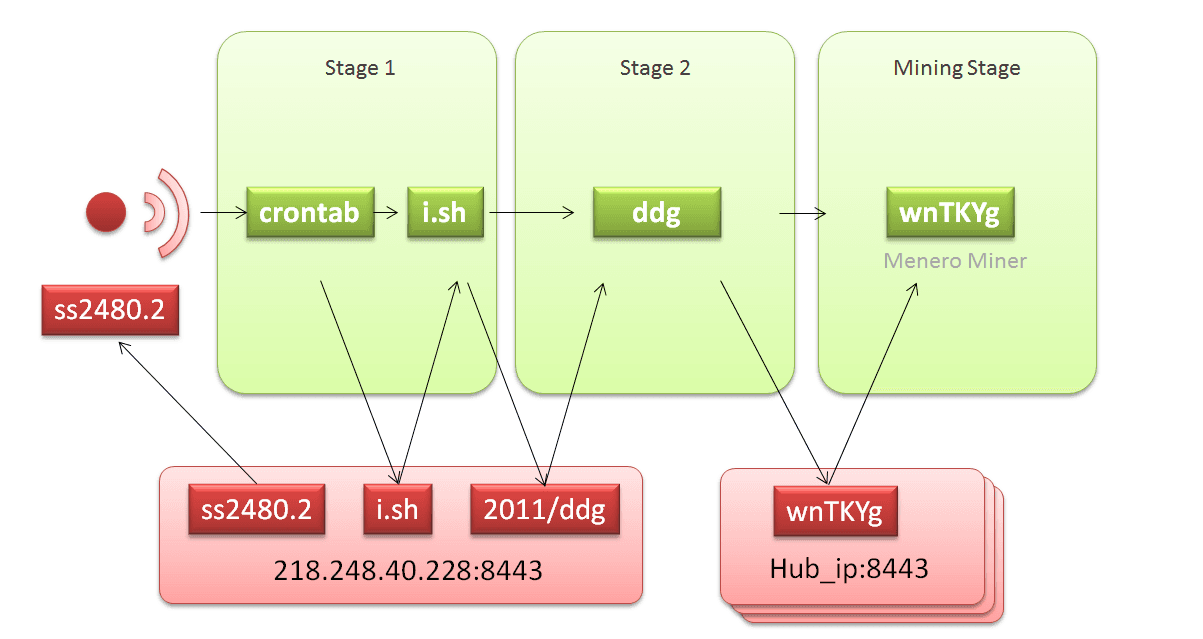
The attack chain described by the researchers from Qihoo 360’s Netlab is composed of the following steps:
- Initial Scanning: The attacker (ss2480.2) exploits the known RCE vulnerability of the OrientDB database and drops the attack payload
- Stage 1: Attackers modify local Crontab scheduled tasks, download and execute i.sh (hxxp: //218.248.40.228:8443/i.sh) on the primary server and keep it synchronized every 5 minutes
- Stage 2: DDG traverses the built-in file hub_iplist.txt, check the connectivity of every single entry and try to download the corresponding Miner program wnTKYg from the one can be successfully connected (wnTKYg.noaes if the native CPU does not support AES-NI)
- Mining Stage: The Miner program begins to use the computing resources of the compromised host to begin mining for the attacker’s wallet.
The following image shows the DDG Mining Botnet attack process:

The researchers conducted sinkholing of the botnet traffic and observed 4,391 IP addresses of compromised servers from all countries. Most of the infections is in China (73%), followed by the United States (11%), the botnet is mainly composed of compromised Redis databases (88%).
Cybercriminals are using three wallet addresses, the botnet mined 3,395 Monero ($925,000), but researchers also discovered another wallet containing 2,428 Monero ($660,000).
“The total income is Monroe 3,395 or 5,760. These tokens are worth USD 925,383 or 1,569,963 today. Note: There is an issue for the second wallet, where “Total Paid” is not consistent with the summary of all tractions’ amount. We cannot confirm which number is more accurate, so we show both numbers here.” continues the analysis.

Further information including the IoCs are included in the technical report published by Qihoo 360’s Netlab.
| [adrotate banner=”9″] | [adrotate banner=”12″] |
(Security Affairs – DDG botnet, mining)
[adrotate banner=”5″]
[adrotate banner=”13″]


