
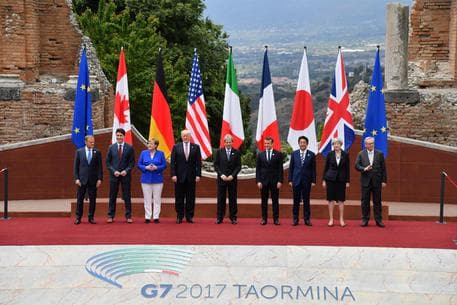
(L-R): EU Council President Donald Tusk, Canadian Prime Minister Justin Trudeau, German Chancellor Angela Merkel, US President Donald Trump, Italian Prime Minister Paolo Gentiloni, French President Emmanuel Macron, Japanese Prime Minister Shinzo Abe, British Prime Minister Theresa May and European Union Commission President Jean-Claude Juncker pose for a family photo on the first day of the G7 Summit at the Teatro Greco in Taormina, Italy, 26 May 2017. The G7 Summit will be held from 26 to 27 May 2017. ANSA/ETTORE FERRARI ANSA/ETTORE FERRARI
The French government announced a “Paris Call” for global talks about cyberspace security aimed at laying out a shared framework of rules.
The French government is promoting a series of Global Talks on cyberspace security, it urges for a “code of good conduct” for states in the cyberspace.
Events such as the interference in the 2016 Presidential election or massive attacks like WannaCry and NotPetya increase the sense of urgency among states.
The risk of escalation and retaliation in cyberspace, the increasing number of cyber attacks and cyber threats even more sophisticated could have a destabilizing effect on international peace and security. The risk of conflict between states caused so cyber incidents encourages all States to engage in law-abiding, norm-respecting and confidence-building behavior in their use of ICT.
I’m one of the authors of the G7 DECLARATION ON RESPONSIBLE STATES BEHAVIOR IN CYBERSPACE that were signed in 2017 during the Italy G7 meeting.
I had the honor to be a member of the group that worked on the proposal for voluntary, non-binding norms of State behavior during peacetime. We presented 12 points aimed to propose stability and security in the cyberspace. The declaration invites all the States to collaborate with the intent to reduce risks to international peace, security, and stability.
The decision of the French government aims to relaunch the discussion of the adoption of a framework for norms of state behavior in the cyberspace, a sort of prosecution of the work started last year during the G7 meeting.
“Officials said the text, to be presented by President Emmanuel Macron as he opens UNESCO’s Internet Governance Forum in Paris on Monday, has been signed by most European countries.” reads the press release published by AFP.
During the G7 meeting emerged the need to open the discussion to other states, including China, Russia, and India.
Now China, Russia, and the United States have not yet joined to the initiative, even if major firms and organizations like Microsoft and the NGO Internet Society believe that a supplementary effort is essential to define the framework.
“The identity and number of signatories are to be released later Monday, following a lunch hosted at the Elysee Palace by Macron for dozens of technology executives and officials.” continues the AFP.
“To respect people’s rights and protect them online as they do in the physical world, states must work together, but also collaborate with private-sector partners, the world of research and civil society,”
Security in the cyberspace could be improved only through the active participation of any government, for this reason, it is urgent the definition and the approval in a mandatory way of a set of shared roles. The work we made during the G7 was an excellent starting point for further discussions on a global scale.
“It’s a domain that is managed, but not governed,” an adviser to Macron said, warning that a “free, open and secure” internet risked quickly becoming a thing of the past.
Let me close with a polemical note, in Italy the G7 group that has worked to the declaration has been dismantled and no action has been taken anymore.
| [adrotate banner=”9″] | [adrotate banner=”12″] |
(Security Affairs – Cyberspace security, France)
[adrotate banner=”5″]
[adrotate banner=”13″]


