
Security researchers at Morphisec have uncovered a massive hacking campaign that is exploiting the recently patched CVE-2018-4878 Adobe Flash Player vulnerability.
Threat actors are exploiting the use-after-free flaw to deliver malware.
The CVE-2018-4878 vulnerability was fixed by Adobe on February 6, after security experts discovered it was used by North Korea-linked APT37 group in targeted attacks against South Korea.
Now the same vulnerability has been exploited by other threat actors in the wild as confirmed by Morphisec. The company spotted a campaign on February 22, the attackers were using a version of the exploit similar to the one used by the APT37 group.
The campaign is attributed to a financially motivated threat actor that exploited the CVE-2018-4878 in a malspam campaign, another thing highlighted by the researchers is that this exploit did not have a 64-bit version like the original one.
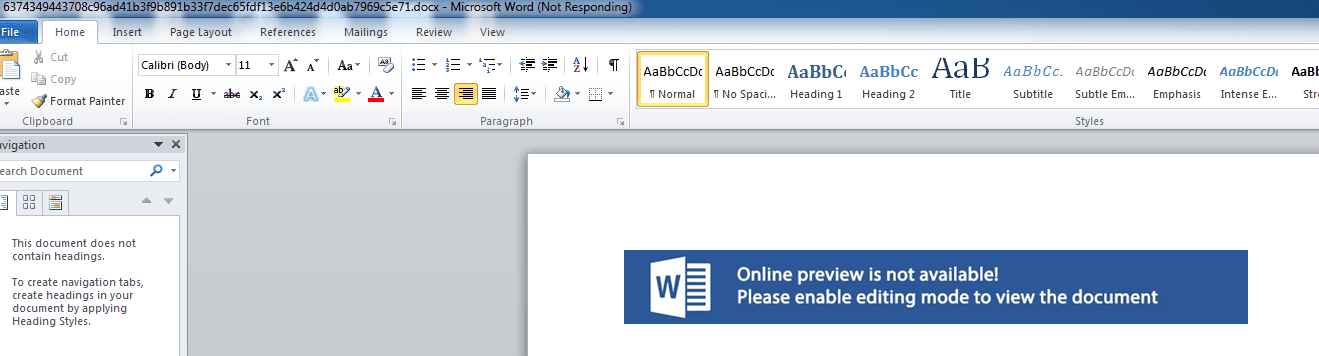
The attackers used spam emails containing a link to a document stored on safe-storage[.]biz. Once downloaded and opened, the document tries to trick victims with social engineering. It notifies users that an online preview is not available and instructs them to enable editing mode in order to view the content.
If the user enables the editing mode, the CVE-2018-4878 Adobe vulnerability is exploited and the Windows command prompt is executed. The associated cmd[.]exe file is then injected with malicious shellcode that connects to the attacker’s domain.
Security researchers at Morphisec have uncovered a massive hacking campaign that is exploiting the recently patched CVE-2018-4878 Adobe Flash Player vulnerability.
Threat actors are exploiting the use-after-free flaw to deliver malware.
The URLs included in the emails is generated by Google’s URL shortening service, this circumstance allowed the researchers to determine the number of victims that clicked it. According to Morphisec each of the different links used in this campaign had been clicked tens and even hundreds of times within 3-4 days of being created.

“On February 22, 2018, Morphisec Labs spotted several malicious word documents exploiting the latest Flash vulnerability CVE-2018-4878 in the wild in a massive malspam campaign.” states the analysis published by Morphisec.
“After downloading and opening the Word document, the attack exploits the Flash vulnerability 2018-4878 and opens a cmd[.]exe which is later remotely injected with a malicious shellcode that connects back to the malicious domain.”
Then the shellcode downloads a dll from the same domain, which is executed using Microsoft Register Server utility to bypass whitelisting solutions.
According to the experts, only a limited number of security solutions flag the bait documents as malicious.
“As expected and predicted, adversaries have quickly adopted the Flash exploit, which is easily reproducible. With small variations to the attack, they successfully launched a massive malspam campaign and bypassed most of the existing static scanning solutions once again.” concluded Morphisec.
| [adrotate banner=”9″] | [adrotate banner=”12″] |
(Security Affairs – CVE-2018-4878, hacking)
[adrotate banner=”5″]
[adrotate banner=”13″]


