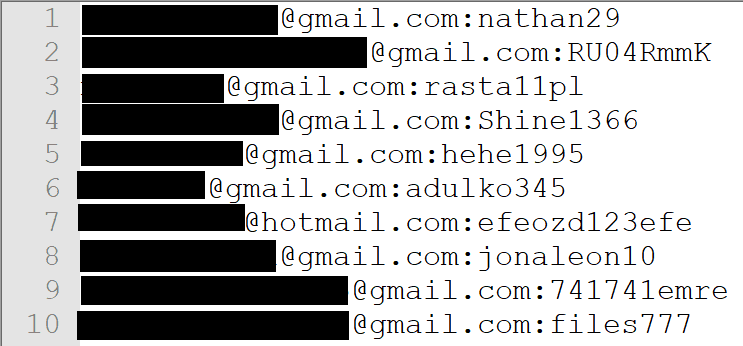
According to Akamai’s latest State of the Internet report on credential stuffing, credential stuffing continues to be growing threat.
According to Akamai report titled “[state of the internet] / security CREDENTIAL STUFFING ATTACKS“ the credential stuffing attacks are a growing threat and often underestimated.
Credential stuffing attacks involve botnets to try stolen login credentials usually obtained through phishing attacks and data breaches. This kind of attacks is very efficient due to the bad habit of users of reusing the same password over multiple services.
The experts detected 8.3 Billion malicious login attempts from bots in May and June, an overall number of 30 billion malicious logins were observed between November 2017 and June 2018, an average of 3.75 billion per month.
“These botnets attempt to log into a target site in order to assume an identity, gather information, or steal money and goods.” states the report published by Akamai.
“They use lists of usernames and passwords gathered from the breaches you hear about nearly every day on the news. They’re also one of the main reasons you should be using a password manager to create unique and random strings for your passwords.”
According to the experts, botnets involved in the attacks across multiple domains, attempt to hide their activity using a low volume of attempts in a long time, a method referred with the term “low and slow.” This technique allows attackers to hide malicious logins within the normal traffic volumes.
Financial and retail sectors are the most targeted by hackers using this attack technique simply because it is easy for attackers to monetize their efforts by compromising customers’ accounts.
The report describes a large credential-stuffing attack on a US credit union, the malicious login traffic had spiked from a daily average of 800 per hour to 8,723 attempts per hour. During the week, the union observed 315,000 malicious login attempts from nearly 20,000 different IP addresses, while the number of HTTP User Agent connections was 4,382 from fewer than 2,000 autonomous system numbers.

In another attack, a large financial services institution received over 350,000 login attempts in just one afternoon.
Most of the credential stuffing attacks were originated in the US (2.82 billion attempts), followed by Russia (1.55 billion attempts). Most of the targets are located in the US because data of American citizens are involved in a large number of data breaches.
“One of the main reasons many organizations don’t have stronger controls to prevent credential stuffing is that 70% of the people surveyed believe the tools needed to defend against these attacks diminish the web experience of legitimate users.” concludes the report published by the experts.
“Clearly, credential stuffing defenses need to able to function without introducing user lag to be successful.”
| [adrotate banner=”9″] | [adrotate banner=”12″] |
(Security Affairs – credential stuffing, hacking)
[adrotate banner=”5″]
[adrotate banner=”13″]