
Europe Confirms Record €4.1B Penalty Against Google for Android Practices|U.S. CISA adds a Microsoft SharePoint Server flaw to its Known Exploited Vulnerabilities catalog|430,000 FortiGate Devices Exposed in FortiBleed Ransomware Link|Adobe fixed multiple maximum-severity flaws in ColdFusion and Campaign Classic|Alleged Scattered Spider Hacker Extradited to U.S. to Face Cybercrime Charges|Oracle E-Business Suite Flaw Under Active Attack, 950 Systems Exposed|Azure CLI Targeted in LSHIY Password Spray Campaign Across 64 Orgs|CISA Warns BlueHammer Flaw Is Now Exploited in Ransomware Attacks|RustDuck: The Botnet That’s Still Small but Engineering Like It Plans to Grow|GuardFall Flaw Hits 10 of 11 Popular Open-Source AI Agents|XSS.is, The Forum That Ran the Ransomware Supply Chain Is Down. The Market Isn’t|U.S. CISA adds SimpleHelp flaw to its Known Exploited Vulnerabilities catalog|Europe Confirms Record €4.1B Penalty Against Google for Android Practices|U.S. CISA adds a Microsoft SharePoint Server flaw to its Known Exploited Vulnerabilities catalog|430,000 FortiGate Devices Exposed in FortiBleed Ransomware Link|Adobe fixed multiple maximum-severity flaws in ColdFusion and Campaign Classic|Alleged Scattered Spider Hacker Extradited to U.S. to Face Cybercrime Charges|Oracle E-Business Suite Flaw Under Active Attack, 950 Systems Exposed|Azure CLI Targeted in LSHIY Password Spray Campaign Across 64 Orgs|CISA Warns BlueHammer Flaw Is Now Exploited in Ransomware Attacks|RustDuck: The Botnet That’s Still Small but Engineering Like It Plans to Grow|GuardFall Flaw Hits 10 of 11 Popular Open-Source AI Agents|XSS.is, The Forum That Ran the Ransomware Supply Chain Is Down. The Market Isn’t|U.S. CISA adds SimpleHelp flaw to its Known Exploited Vulnerabilities catalog|
Advertisement

Ad Placeholder

Full Width × 90

Breaking News

Cloak ransomware group hacked the Virginia Attorney General’s Office

The Cloak ransomware group claims responsibility for a cyberattack on the Virginia Attorney General’s Office that occurred in February. The ransomware group Cloak has claimed responsibility for a February cyberattack on the Virginia Attorney General Office. A cyberattack on the Virginia Attorney General’s Office forced officials to shut down IT systems, including email and VPN, […]

Virginia Attorney General’s Office

The Cloak ransomware group claims responsibility for a cyberattack on the Virginia Attorney General’s Office that occurred in February.

The ransomware group Cloak has claimed responsibility for a February cyberattack on the Virginia Attorney General Office.

A cyberattack on the Virginia Attorney General’s Office forced officials to shut down IT systems, including email and VPN, and revert to paper filings. Chief Deputy AG Steven Popps called it a “sophisticated attack.” The breach was detected in February, leading to notifications to the FBI, Virginia State Police, and the Virginia Information Technologies Agency. Investigations are ongoing to assess the impact and source of the attack.

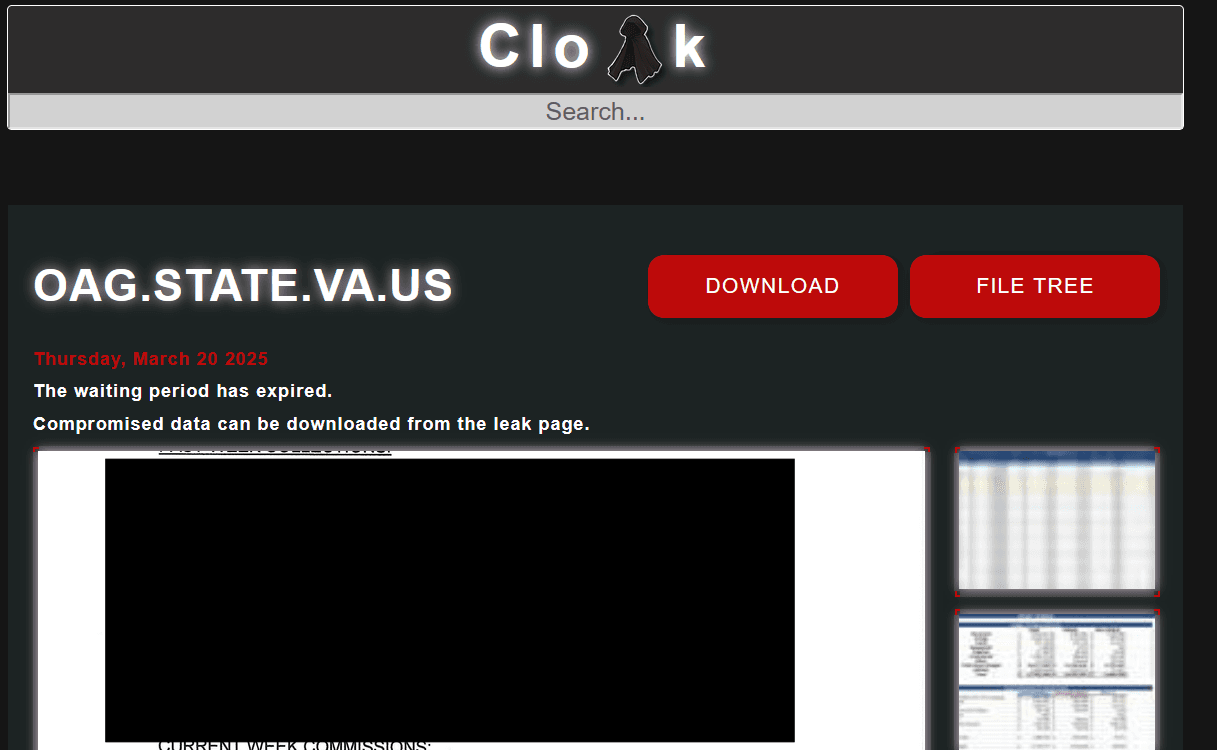
The Virginia Attorney General’s Office did not share details about the attack. On March 20, 2025, the group added the VA General’s Office to the list of victims on its Tor leak site.

The group said that the waiting period had expired and claimed the theft of 134GB of sensitive data.

Initially, the group published screenshots of stolen data as proof of the attack, now the whole archive can be downloaded from the leak page.

The Cloak ransowmare group has been active since at least 2023 and breached more than one hundred organizations across the years.

“Cloak primarily targets small to medium-sized businesses in Europe, with Germany as a key focus. The group has extended its operations to countries in Asia and targets various sectors, including healthcare, real estate, construction, IT, food, and manufacturing.” reads a report published by Halcyon. “Cloak’s attack strategy involves acquiring network access through Initial Access Brokers (IABs) or social engineering methods such as phishing, malvertising, exploit kits, and drive-by downloads disguised as legitimate updates like Microsoft Windows installers.”

The group uses an ARCrypter ransomware variant, derived from Babuk’s leaked code, to encrypt files after infiltrating a network.

Follow me on Twitter: @securityaffairs and Facebook and Mastodon

Pierluigi Paganini

(SecurityAffairs – hacking, ransomware)


