
Security Affairs
Dark Caracal Deploys New Go Malware With Ethereum-Based C2 Fallback|Australian Police Charge Two Over TeamPCP Credential Theft|Meta to Pay Up to $18B Over Teen Social Media Use|CISA Warns Water Utilities: Find Your Exposed PLCs Before Attackers Do|OpenAI banned Russian ChatGPT accounts backing covert influence operation|CISA Red Team Fully Compromised Two Critical Infrastructure Orgs|FBI Seizes China-Linked Hacking Platforms QScan and QTRouter Used Against Critical Infrastructure|U.S. CISA adds Gitea flaw to its Known Exploited Vulnerabilities catalog|88 ID Verification Breaches Show the Cost of Collecting Identity Data|WhatsApp Adds Stronger Security as Passkeys Hit 1 Billion|Operation Jackal: 58 Arrests Expose the Money Laundering Machine Behind Global Scams|Norway ’s Digital Government Infrastructure Hit by a new DDoS Attack|Dark Caracal Deploys New Go Malware With Ethereum-Based C2 Fallback|Australian Police Charge Two Over TeamPCP Credential Theft|Meta to Pay Up to $18B Over Teen Social Media Use|CISA Warns Water Utilities: Find Your Exposed PLCs Before Attackers Do|OpenAI banned Russian ChatGPT accounts backing covert influence operation|CISA Red Team Fully Compromised Two Critical Infrastructure Orgs|FBI Seizes China-Linked Hacking Platforms QScan and QTRouter Used Against Critical Infrastructure|U.S. CISA adds Gitea flaw to its Known Exploited Vulnerabilities catalog|88 ID Verification Breaches Show the Cost of Collecting Identity Data|WhatsApp Adds Stronger Security as Passkeys Hit 1 Billion|Operation Jackal: 58 Arrests Expose the Money Laundering Machine Behind Global Scams|Norway ’s Digital Government Infrastructure Hit by a new DDoS Attack|
Advertisement

Ad Placeholder

Full Width × 90

Breaking News

Clickjacking Campaign exploits the European Cookie Law

Experts at MalwareBytes discovered a clickjacking campaign that tricks users into clicking on what looks like a legitimate European cookie law notification. Cyber criminals always exploit any opportunity to make profits, news of the day is they are abusing of the legitimate European Cookie Law notices in clever clickjacking campaign. The clickjacking campaign recently discovered […]

Clickjacking Campaign exploits the European Cookie Law

Experts at MalwareBytes discovered a clickjacking campaign that tricks users into clicking on what looks like a legitimate European cookie law notification.

Cyber criminals always exploit any opportunity to make profits, news of the day is they are abusing of the legitimate European Cookie Law notices in clever clickjacking campaign.

The clickjacking campaign recently discovered exploits pop-up alerts that the European Cookie Law is requesting to show to the websites’ visitors.

European websites have to request explicit consent to the users to place a cookie on their computer for commercial purposes, the request is made by displaying a notification pop-up .

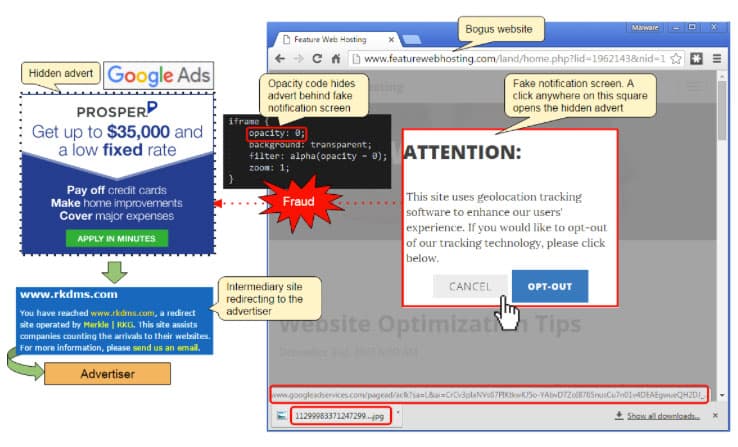
Cyber criminals are exploiting the pop-up by placing a legitimate ad banner on top of the message via an iframe. The crooks deceive the websites’ visitors by using an invisible ad, this is possible by setting the opacity of the frame to zero.

This implies that every time users click on the fake pop-up notification are not aware that they are also clicking on the ad hidden in the message.

clickjacking European cookie law

“The rogue actors behind this fraudulent activity are cleverly leveraging a European law on the use of cookies to seemingly prompt visitors to answer a question.” states a blog post published by Malwarebytes. “While simple, this technique, also known as clickjacking, is pretty effective at generating clicks that look perfectly legitimate and performed by real human beings as opposed to bots.”

“This is costing advertisers and ad networks a lot of money while online crooks are profiting from bogus Pay Per Click traffic.”

The specific clickjacking campaign observed by Malwarebytes is not dangerous for the visitors, but cybercriminals could also exploit the same technique to trick users into clicking on malicious links, redirecting victims on malware hosting exploit kits.

Pierluigi Paganini

(Security Affairs – clickjacking , European Cookie Law)


