
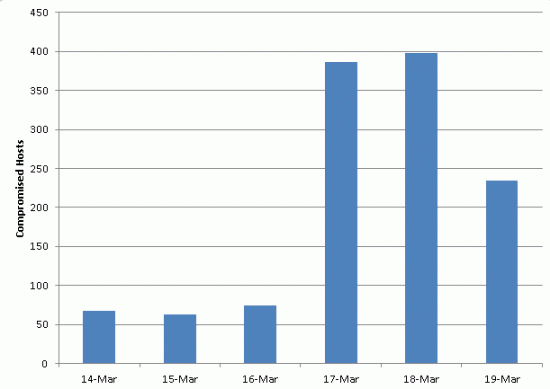
Cisco observed 400 hosts were infected on daily base and more than 2,700 URLs have been used in a multistage attack against websites running older OS versions.
In the last months a growing number of large-scale attacks hit systems all over the world, many of them, like the Snake campaign, are attributable to state-sponsored hackers others conducted by groups of cyber criminals. In the majority of the cases, attackers exploited well-known vulnerabilities not patched by the administrators. A recent research published by Imperva on exploits for a two-year-old PHP vulnerability demonstrated that about 16 percent of the sites on the web are vulnerable to the bug in PHP versions 5.4.x, 5.3.x before 5.4.2 or 5.3.12. Another source of the problem is represented by the web servers running older versions of the OS, it is the case, for example, if the machine still running Linux 2.6 kernel, a version released seven years ago. Old versions of OSs are no more under maintenance, every flaw still present will be never fixed for the interruption of updates release and attackers can benefit of this circumstance if they are able to identify and exploit these bugs. Cisco recently noted 400 distinct hosts were infected on daily base and more than 2,700 URLs have been used in the attack, in many cases belonging to legitimate websites that were compromised. The victims were located mainly in the United States, Germany and Spain according Cisco researchers.

Martin Lee, a researcher with Cisco, wrote a blog post on the topic, focusing its analysis on a malicious redirection campaign driven by unauthorized access to thousands of websites running older version of OS. The problem is not limited to Linux kernel 2.6, but it transversal to all server OS no mote supported by their communities.
“This large scale compromise of an aging operating system highlights the risks posed by leaving such systems in operation. Systems that are unmaintained or unsupported are no longer patched with security updates,”“When attackers discover a vulnerability in the system, they can exploit it at their whim without fear that it will be remedied.” “It is possible that attackers have identified a vulnerability on the platform and have been able to take advantage of the fact that these are older systems that may not be continuously patched by administrators,” said Lee.
Security experts identified a multistage attack where compromised websites redirect visitors to second server used to serve malware following a click fraud scam scheme in which victim’s browser displays a number of ads. It is likely that the second server is also used to make give persistence to the attack through the inoculation of a backdoor Trojan.
“The attack itself happens in multiple stages. Attackers compromise an existing website, append a line of JavaScript to multiple .js files hosted on the site. This causes visitors to load and run a new JavaScript file served from a second compromised host. Utilising a two stage process allows attackers to serve up a variety of malicious content to the visitor.” reports the official post.
 The redirection technique adopted by the attackers is similar to that previously used in the Blackhole exploit kit, but there is no evidence of a direct link to the popular crimeware kit, experts in fact revealed that the campaign could be part of a Mesh Network attack described by Sucuri early in 2014. System administrators must carefully consider operating systems in phase-out and implement a policy to update their system to the latest versions.proper patch levels up to par.
(Security Affairs – Cisco, servers)


