
Security Affairs
Dark Caracal Deploys New Go Malware With Ethereum-Based C2 Fallback|Australian Police Charge Two Over TeamPCP Credential Theft|Meta to Pay Up to $18B Over Teen Social Media Use|CISA Warns Water Utilities: Find Your Exposed PLCs Before Attackers Do|OpenAI banned Russian ChatGPT accounts backing covert influence operation|CISA Red Team Fully Compromised Two Critical Infrastructure Orgs|FBI Seizes China-Linked Hacking Platforms QScan and QTRouter Used Against Critical Infrastructure|U.S. CISA adds Gitea flaw to its Known Exploited Vulnerabilities catalog|88 ID Verification Breaches Show the Cost of Collecting Identity Data|WhatsApp Adds Stronger Security as Passkeys Hit 1 Billion|Operation Jackal: 58 Arrests Expose the Money Laundering Machine Behind Global Scams|Norway ’s Digital Government Infrastructure Hit by a new DDoS Attack|Dark Caracal Deploys New Go Malware With Ethereum-Based C2 Fallback|Australian Police Charge Two Over TeamPCP Credential Theft|Meta to Pay Up to $18B Over Teen Social Media Use|CISA Warns Water Utilities: Find Your Exposed PLCs Before Attackers Do|OpenAI banned Russian ChatGPT accounts backing covert influence operation|CISA Red Team Fully Compromised Two Critical Infrastructure Orgs|FBI Seizes China-Linked Hacking Platforms QScan and QTRouter Used Against Critical Infrastructure|U.S. CISA adds Gitea flaw to its Known Exploited Vulnerabilities catalog|88 ID Verification Breaches Show the Cost of Collecting Identity Data|WhatsApp Adds Stronger Security as Passkeys Hit 1 Billion|Operation Jackal: 58 Arrests Expose the Money Laundering Machine Behind Global Scams|Norway ’s Digital Government Infrastructure Hit by a new DDoS Attack|
Advertisement

Ad Placeholder

Full Width × 90

Breaking News

CERT-UA warned of scammers impersonating the agency using fake AnyDesk requests

CERT-UA warned of scammers impersonating the agency, using fake AnyDesk requests to conduct fraudulent security audits. The Computer Emergency Response Team of Ukraine (CERT-UA) warned of cyber scams involving threat actors impersonating the agency by sending fraudulent AnyDesk connection requests under the guise of security audits. CERT-UA pointed out that it uses the software AnyDesk […]

CERT-UA AnyDesk

CERT-UA warned of scammers impersonating the agency, using fake AnyDesk requests to conduct fraudulent security audits.

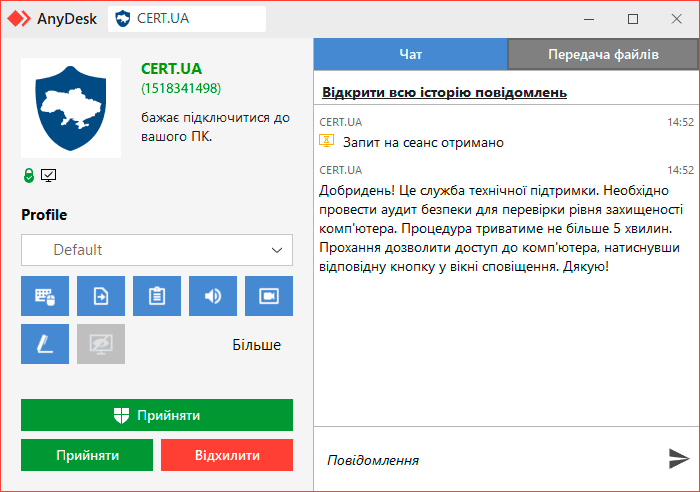
The Computer Emergency Response Team of Ukraine (CERT-UA) warned of cyber scams involving threat actors impersonating the agency by sending fraudulent AnyDesk connection requests under the guise of security audits.

CERT-UA AnyDesk

CERT-UA pointed out that it uses the software AnyDesk in some cases, but only with prior approval via official channels.

“The Ukrainian government’s computer emergency response team, CERT-UA, has received information about numerous cases of attempts to connect to computers using the AnyDesk program, allegedly on behalf of CERT-UA.” reads the advisory published by CERT-UA. “Thus, unidentified individuals send requests to connect to AnyDesk under the pretext of conducting a “security audit to check the level of security”, using the name “CERT.UA”, the CERT-UA logo, and the AnyDesk identifier “1518341498” (may change).”

Threat actors are attempting to use social engineering techniques by exploiting the trust of local entities in the authority.

The threat actors need to have the victim’s AnyDesk ID to carry out the attack and the software must be active on the target systems. The researchers explained that attackers can retrieve a compromised ID from “prior unauthorized access on other devices or circumstances.”

CERT-UA recommends enabling remote access software only during active use, confirming remote work through official channels, and reporting anomalies promptly.

At present, CERT-UA has not attributed the attacks to any Russian APT group active against Ukraine since the start of the conflict (e.g. UAC-0010, UAC-0050 and UAC-0006). The alert also does not specify the targets of the attack, information that could provide useful insights into the attackers’ motivations and help attribute the campaign.

Follow me on Twitter: @securityaffairs and Facebook and Mastodon

Pierluigi Paganini

(SecurityAffairs – hacking, Ukraine)


