
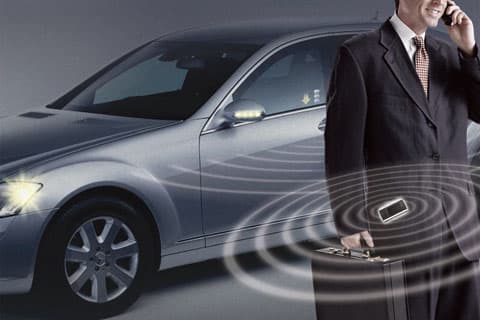
A recent wave of car burglaries raises the debate on possible hacking techniques adopted by car thieves .. Signal amplification and brute-force attacks.
A few months ago the journalist Nick Bilton wrote about his car being broken into in front of him. Bilton believes that his car was stolen by using snatched with the help of a signal repeater that amplified the range of the keyless entry fob. Similar car burglaries were reported in southern California in 2013.
Swiss-based security Boris Danev in 2010 published the paper “Relay Attacks on Passive Keyless Entry and Start Systems in Modern Cars” described the exploitation of the vulnerability of keyless entry fobs by using signal amplification. Danev exploit was possible by using lab equipment and an AC power supply, but is it possible to obtain the same results by using low-cost and portable devices like a common key fob?
Recently, Bozi Tatarevic at The Truth About Cars wrote up his attempt to test this potential exploit in quite some detail, he explained that unable to implement Danev’s approach to creating a low-cost cordless signal amplifier.
Tatarevic concludes that the recent wave of burglaries were more likely caused by thieves that run brute force attacks against the rolling codes that some manufacturers use for their unlocking signals.

The technique was presented last year at the Black Hat conference by the security expert Silvio Cesare. During his talk Cesare revealed a technique to spoof the signal from a wireless key fob and unlock a car by using a codebreaking attack. The researcher explained that the attack takes as little as a few minutes to run.
“I can use this to lock, unlock, open the trunk,” says Cesare. “It effectively defeats the security of the keyless entry.”
At the time of the speech, Cesare revealed that the hack requires off-the-shelf tools that cost more than $1,000 and may require the attacker to remain within wireless range of the car for as long as two hours.
The researcher used a laptop and a software-defined radio (SDR) to run a brute force attack on the car code to unlock the doors.
This is not the unique way to hack into a car, another option for car thieves is the use of SDR and RF jamming to capture the car code and reuse it later.
Basically the attackers jam the receiver in order to avoid the reception of the unlock code, in this way the car is not able to recognize the legitimate signal from the key fob.
“Daily Tech—also skeptical of Bilton and Danev’s theory—looked at passive key fob attacks and found devices on sale that claimed to be able to replicate rolling codes used by car manufacturers.” reported Ars.
Unfortunately, all these methods demonstrate that car thieves have many weapons in their arsenal.
| [adrotate banner=”9″] | [adrotate banner=”12″] |
(Security Affairs – car thieves, cybercrime)
[adrotate banner=”5″]
[adrotate banner=”13″]


