
U.S. CISA adds a Microsoft SharePoint Server flaw to its Known Exploited Vulnerabilities catalog|430,000 FortiGate Devices Exposed in FortiBleed Ransomware Link|Adobe fixed multiple maximum-severity flaws in ColdFusion and Campaign Classic|Alleged Scattered Spider Hacker Extradited to U.S. to Face Cybercrime Charges|Oracle E-Business Suite Flaw Under Active Attack, 950 Systems Exposed|Azure CLI Targeted in LSHIY Password Spray Campaign Across 64 Orgs|CISA Warns BlueHammer Flaw Is Now Exploited in Ransomware Attacks|RustDuck: The Botnet That’s Still Small but Engineering Like It Plans to Grow|GuardFall Flaw Hits 10 of 11 Popular Open-Source AI Agents|XSS.is, The Forum That Ran the Ransomware Supply Chain Is Down. The Market Isn’t|U.S. CISA adds SimpleHelp flaw to its Known Exploited Vulnerabilities catalog|Hackers Steal Data of 4.38 Million Aflac Japan Customers|U.S. CISA adds a Microsoft SharePoint Server flaw to its Known Exploited Vulnerabilities catalog|430,000 FortiGate Devices Exposed in FortiBleed Ransomware Link|Adobe fixed multiple maximum-severity flaws in ColdFusion and Campaign Classic|Alleged Scattered Spider Hacker Extradited to U.S. to Face Cybercrime Charges|Oracle E-Business Suite Flaw Under Active Attack, 950 Systems Exposed|Azure CLI Targeted in LSHIY Password Spray Campaign Across 64 Orgs|CISA Warns BlueHammer Flaw Is Now Exploited in Ransomware Attacks|RustDuck: The Botnet That’s Still Small but Engineering Like It Plans to Grow|GuardFall Flaw Hits 10 of 11 Popular Open-Source AI Agents|XSS.is, The Forum That Ran the Ransomware Supply Chain Is Down. The Market Isn’t|U.S. CISA adds SimpleHelp flaw to its Known Exploited Vulnerabilities catalog|Hackers Steal Data of 4.38 Million Aflac Japan Customers|
Advertisement

Ad Placeholder

Full Width × 90

Breaking News

An unpatchable flaw in CAN protocol expose modern cars to hack

Experts discovered a flaw in CAN protocol that could be exploited by an attacker to disable safety systems of connected cars, including power-steering. Almost any function in modern vehicles, from brakes to accelerator, is electronically controlled, this means that the surface of attack is dramatically enlarging. We discussed car hacking several times, experts have demonstrated on different occasions […]

car alarm systems

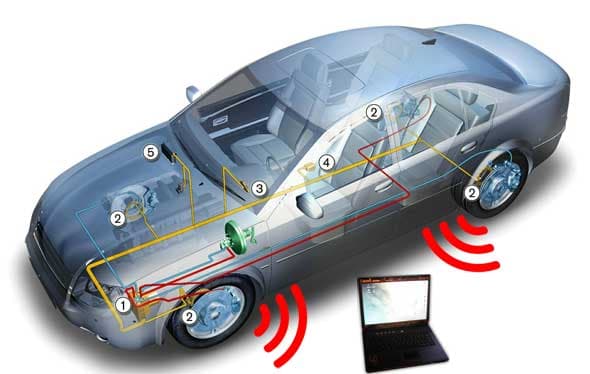
Experts discovered a flaw in CAN protocol that could be exploited by an attacker to disable safety systems of connected cars, including power-steering.

Almost any function in modern vehicles, from brakes to accelerator, is electronically controlled, this means that the surface of attack is dramatically enlarging.

We discussed car hacking several times, experts have demonstrated on different occasions how to hack a modern vehicle or control it remotely.

Now a team of researchers from Trend Micro’s Forward-looking Threat Research (FTR) team, in collaboration with Politecnico di Milano and Linklayer Labs, discovered a critical security vulnerability in the CAN protocol (controller area network) that could be exploited by an attacker to disable airbags and other safety systems of connected cars, including power-steering and anti-lock brakes.
CAN protocol flaw

The CAN bus is a vehicle standard designed to allow components to communicate with each other, it is widespread in automotive and the flaw discovered by the researchers affects a large number of vendors and vehicle models.

The messages exchanged on the CAN, including errors, are called “frames,” the researchers focused their research on how CAN handles errors.


“Our attack focuses on how CAN handles errors. Errors arise when a device reads values that do not correspond to the original expected value on a frame,” read the blog post published by Trend Micro.

“When a device detects such an event, it writes an error message onto the CAN bus in order to “recall” the errant frame and notify the other devices to entirely ignore the recalled frame. This mishap is very common and is usually due to natural causes, a transient malfunction, or simply by too many systems and modules trying to send frames through the CAN at the same time.”

According to the CAN standards, when a component flood the bus with error messages, it goes into a Bus Off state and it is cut it off from the CAN system and making it inoperable.

Abusing this feature, an attacker can force the deactivation of any system connected to the CAN, including security systems like the airbag system or the anti-lock braking system.


The attack scenario sees the attackers using a “specially-crafted attack device” that is connected via local access to the vehicle.

Experts pointed out that transportation trends like ride-sharing and carpooling could make this attack scenario feasible.

Unfortunately, this is a design flaw of the CAN bus messaging protocol used in CAN controller chips, this means that the vulnerability cannot be directly patched with an OTA (on-the-air) upgrade or by recalling the vehicles.

To fix the design flaw, it is necessary to introduce changes in the CAN standards.

The researchers recommended manufacturers to implement network countermeasures to mitigate such attacks:

“Car manufacturers can only mitigate the attack we demonstrated by adopting specific network countermeasures, but cannot eliminate it entirely,” the researchers said.

“To eliminate the risk entirely, an updated CAN standard should be proposed, adopted, and implemented. This whole process would likely require another generation of vehicles.”

[adrotate banner=”9″] [adrotate banner=”12″]

Pierluigi Paganini

(Security Affairs – Car hacking, CAN Protocol)

[adrotate banner=”13″]


