Security Affairs
Russian APT BlueDelta Uses HOOKEDGE to Target Defense and Diplomatic Organizations|PaperCut Zero-Day Under Active Attack: Emergency Patch Released|U.S. CISA adds Red Hat, Linux Kernel, Ajax.NET Professional, Microsoft SQL Server, and Citrix NetScaler flaws to its Known Exploited Vulnerabilities catalog|Cyberattack on UK Airport Operator MAG Exposes Data of 8.7 Million Customers Across Three Airports|Dark Caracal Deploys New Go Malware With Ethereum-Based C2 Fallback|Australian Police Charge Two Over TeamPCP Credential Theft|Meta to Pay Up to $18B Over Teen Social Media Use|CISA Warns Water Utilities: Find Your Exposed PLCs Before Attackers Do|OpenAI banned Russian ChatGPT accounts backing covert influence operation|CISA Red Team Fully Compromised Two Critical Infrastructure Orgs|FBI Seizes China-Linked Hacking Platforms QScan and QTRouter Used Against Critical Infrastructure|U.S. CISA adds Gitea flaw to its Known Exploited Vulnerabilities catalog|Russian APT BlueDelta Uses HOOKEDGE to Target Defense and Diplomatic Organizations|PaperCut Zero-Day Under Active Attack: Emergency Patch Released|U.S. CISA adds Red Hat, Linux Kernel, Ajax.NET Professional, Microsoft SQL Server, and Citrix NetScaler flaws to its Known Exploited Vulnerabilities catalog|Cyberattack on UK Airport Operator MAG Exposes Data of 8.7 Million Customers Across Three Airports|Dark Caracal Deploys New Go Malware With Ethereum-Based C2 Fallback|Australian Police Charge Two Over TeamPCP Credential Theft|Meta to Pay Up to $18B Over Teen Social Media Use|CISA Warns Water Utilities: Find Your Exposed PLCs Before Attackers Do|OpenAI banned Russian ChatGPT accounts backing covert influence operation|CISA Red Team Fully Compromised Two Critical Infrastructure Orgs|FBI Seizes China-Linked Hacking Platforms QScan and QTRouter Used Against Critical Infrastructure|U.S. CISA adds Gitea flaw to its Known Exploited Vulnerabilities catalog|
Advertisement

Ad Placeholder

Full Width × 90

Breaking News

BRATA, the Android RAT that infected only Brazilian users

Security experts at Kaspersky have spotted a new Android remote access tool (RAT) dubbed BRATA used to spy on Brazilian users. Security experts at Kaspersky have discovered a new Android remote access tool (RAT), tracked as BRATA (the name comes from ‘Brazilian RAT Android’), that was used to spy on Brazilian users. The BRATA RAT […]

brata rat

Security experts at Kaspersky have spotted a new Android remote access tool (RAT) dubbed BRATA used to spy on Brazilian users.

Security experts at Kaspersky have discovered a new Android remote access tool (RAT), tracked as BRATA (the name comes from ‘Brazilian RAT Android’), that was used to spy on Brazilian users. The BRATA RAT was first detected in January while spreading via WhatsApp and SMS messages

““BRATA” is a new Android remote access tool malware family. We used this code name based on its description – “Brazilian RAT Android”. It exclusively targets victims in Brazil: however, theoretically it could also be used to attack any other Android user if the cybercriminals behind it want to.” reads the analysis from Kaspersky. “It has been widespread since January 2019, primarily hosted in the Google Play store, but also found in alternative unofficial Android app stores. For the malware to function correctly, it requires at least Android Lollipop 5.0 version. “

The RAT was delivered through the official Google Play Store and also via unofficial Android app stores. The experts have already discovered more than 20 unique BRATA variants in Android apps on the Play Store.

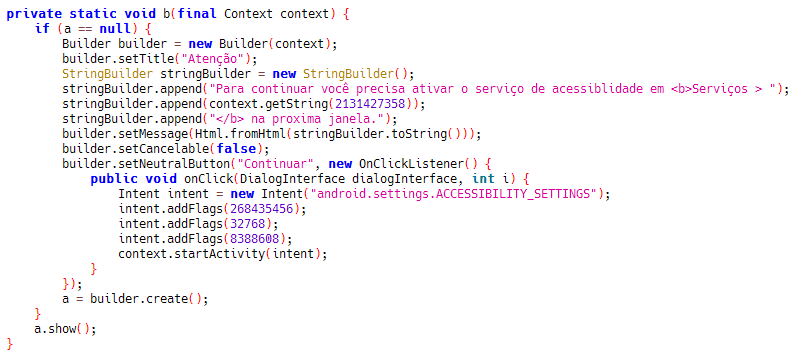
Most of the tainted apps pose as an update to the popular instant messaging application WhatsApp that would address the CVE-2019-3568 flaw in the instant messaging application. Once the malware has infected the victim’s device, it will start keylogging feature, enhancing it with real-time streaming functionality. The malware leverages the Android Accessibility Service feature to interact with other applications installed on the victim’s device.

brata rat

“The cybercriminals behind BRATA use few infection vectors. For example, they use push notifications on compromised websites; and also spread it using messages delivered via WhatsApp or SMS, and sponsored links in Google searches.” continues the report.

BRATA supports many commands, such as unlocking the victims’ devices, collecting device information, turning off the device’s screen to surreptitiously run tasks in the background, executing any particular application and uninstall itself and removes any infection traces.

“It is worth mentioning that the infamous fake WhatsApp update registered over 10,000 downloads in the official Google Play Store, reaching up to 500 victims per day.” concludes Kaspersky.

The report includes indicators of compromise (IOCs) for the BRATA RAT malware.

[adrotate banner=”9″] [adrotate banner=”12″]

Pierluigi Paganini

(SecurityAffairs  BRATA RAT, malware)

[adrotate banner=”5″]

[adrotate banner=”13″]