
U.S. CISA adds a Microsoft SharePoint Server flaw to its Known Exploited Vulnerabilities catalog|430,000 FortiGate Devices Exposed in FortiBleed Ransomware Link|Adobe fixed multiple maximum-severity flaws in ColdFusion and Campaign Classic|Alleged Scattered Spider Hacker Extradited to U.S. to Face Cybercrime Charges|Oracle E-Business Suite Flaw Under Active Attack, 950 Systems Exposed|Azure CLI Targeted in LSHIY Password Spray Campaign Across 64 Orgs|CISA Warns BlueHammer Flaw Is Now Exploited in Ransomware Attacks|RustDuck: The Botnet That’s Still Small but Engineering Like It Plans to Grow|GuardFall Flaw Hits 10 of 11 Popular Open-Source AI Agents|XSS.is, The Forum That Ran the Ransomware Supply Chain Is Down. The Market Isn’t|U.S. CISA adds SimpleHelp flaw to its Known Exploited Vulnerabilities catalog|Hackers Steal Data of 4.38 Million Aflac Japan Customers|U.S. CISA adds a Microsoft SharePoint Server flaw to its Known Exploited Vulnerabilities catalog|430,000 FortiGate Devices Exposed in FortiBleed Ransomware Link|Adobe fixed multiple maximum-severity flaws in ColdFusion and Campaign Classic|Alleged Scattered Spider Hacker Extradited to U.S. to Face Cybercrime Charges|Oracle E-Business Suite Flaw Under Active Attack, 950 Systems Exposed|Azure CLI Targeted in LSHIY Password Spray Campaign Across 64 Orgs|CISA Warns BlueHammer Flaw Is Now Exploited in Ransomware Attacks|RustDuck: The Botnet That’s Still Small but Engineering Like It Plans to Grow|GuardFall Flaw Hits 10 of 11 Popular Open-Source AI Agents|XSS.is, The Forum That Ran the Ransomware Supply Chain Is Down. The Market Isn’t|U.S. CISA adds SimpleHelp flaw to its Known Exploited Vulnerabilities catalog|Hackers Steal Data of 4.38 Million Aflac Japan Customers|
Advertisement

Ad Placeholder

Full Width × 90

Breaking News

Malware campaign abused flawed Avast Anti-Rootkit driver

Threat actors exploit an outdated Avast Anti-Rootkit driver to evade detection, disable security tools, and compromise the target systems. Trellix researchers uncovered a malware campaign that abused a vulnerable Avast Anti-Rootkit driver (aswArPot.sys) to gain deeper access to the target system, disable security solutions, and gain system control. This alarming tactic corrupts trusted kernel-mode drivers, […]

Avast Anti-Rootkit driver

Threat actors exploit an outdated Avast Anti-Rootkit driver to evade detection, disable security tools, and compromise the target systems.

Trellix researchers uncovered a malware campaign that abused a vulnerable Avast Anti-Rootkit driver (aswArPot.sys) to gain deeper access to the target system, disable security solutions, and gain system control. This alarming tactic corrupts trusted kernel-mode drivers, transforming them into tools for terminating protective processes and compromising infected systems.

Threat actors targeted multiple products including Avast, ESET, McAfee, Microsoft Defender, SentinelOne, Sophos, and Trend Micro.

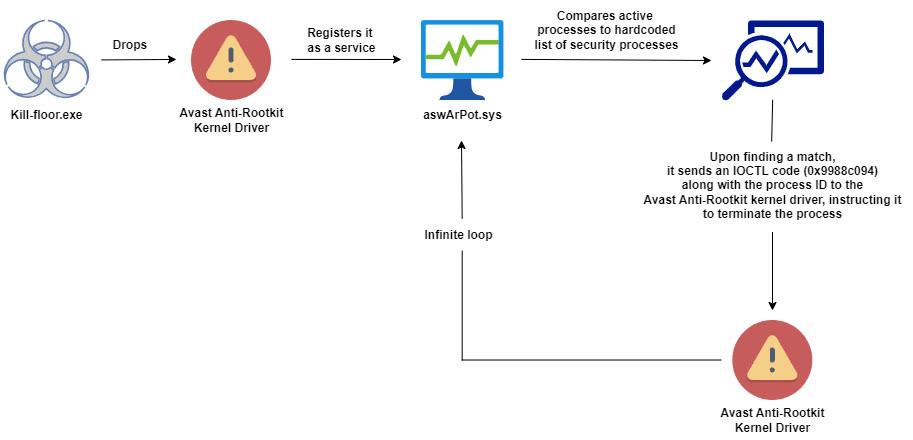
“The malware’s (kill-floor.exe) infection chain begins by dropping a legitimate Avast Anti-Rootkit driver (aswArPot.sys). The malware drops the legitimate kernel driver as ‘ntfs.bin’ in the ‘C:\Users\Default\AppData\Local\Microsoft\Windows’ directory” reads the report published by Trellix.

“Once the legitimate kernel driver is dropped, the malware uses Service Control (sc.exe) to create a service ‘aswArPot.sys’ that registers the driver for further actions. With the driver installed and running, the malware gains kernel-level access to the system, providing it with the ability to terminate critical security processes and take control of the system.”

Avast Anti-Rootkit driver

The Avast Anti-Rootkit driver aswArPot.sys operates at the kernel level, allowing the malware to obtain unrestricted access to the operating system. 

The malware includes a list of 142 hardcoded security process names associated with products from various vendors.

Organizations should implement BYOVD (Bring Your Own Vulnerable Driver) protections to protect systems from attacks using vulnerable drivers. These attacks exploit legitimate but flawed drivers to gain kernel-level access, bypassing security. Deploying expert rules to detect and block such drivers based on their unique signatures or hashes is essential.

The report includes Indicators of compromise (IoCs) for this campaign.

Follow me on Twitter: @securityaffairs and Facebook and Mastodon

Pierluigi Paganini

(SecurityAffairs – hacking, Anti-Rootkit driver)


