
A security researcher has discovered that a threat actor controlled roughly 23% of the Tor network’s exit nodes.
A security researcher named Nusenu revealed that in May a malicious controlled roughly 23% of the entire Tor network’s exit nodes. Experts warn that this was the first time that a single actor controlled such a large number of Tor exit nodes.
A Tor exit relay is the final relay that Tor traffic passes through before it reaches the intended destination. The Tor traffic exits through these relays, this means that the IP address of the exit relay is interpreted as the source of the traffic. Tor Exit relays advertise their presence to the entire Tor network, so they can be used by any Tor users.
Controlling these relays it is possible to see which website the user connects to and, if an unsecure connection is used, it is also possible to manipulate traffic.
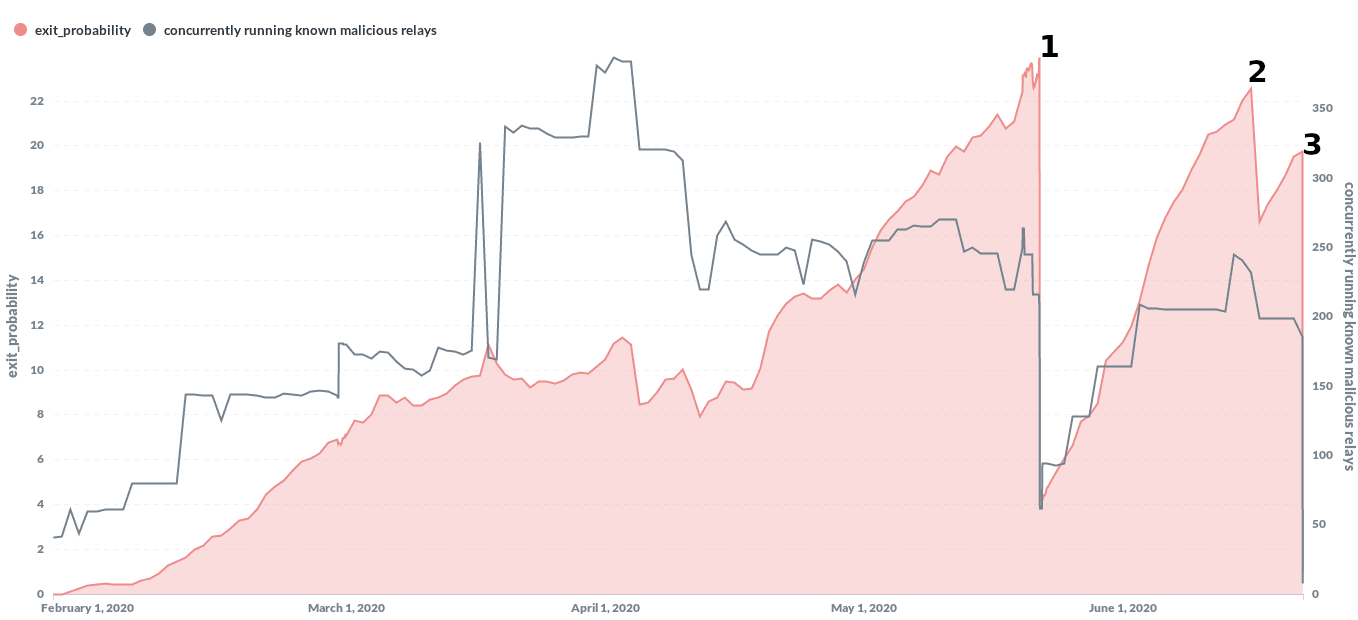
In May, a malicious actor managed to control over 380 Tor exit nodes, with a peak on May 22, when he controlled the 23.95% of Tor exit relay.

“Figure 1 shows what accumulated fraction of the Tor network’s exit capacity was controlled by the malicious actor and how many confirmed malicious relays were concurrently running (peak at over 380 relays).” reads the analysis published by the expert. “Figure 1 also tells us that we opened up Tor Browser at the peak of the attack on 2020–05–22 you had a 23.95% chance to end up choosing an attacker controlled Tor exit relay. Since Tor clients usually use many Tor exit relays over time the chance to use a malicious exit relay increases over time.”
They were removed, but the threat actors restored them as Tor relays after declaring them as a group using the so-called “MyFamily” setting.
In May, most of the nodes were removed, but they were able to grow from 4% exit capability to over 22% in a few weeks.
“The 3 sharp drops in figure 1 (marked with 1, 2, 3) depict the events when some of these malicious Tor exits got detected, reported and removed from the network by the Tor directory authorities. This also shows us how fast the malicious entity recovered from a single removal event and that we didn’t detect all of them at the same time.” continues the report. “It took them less than 30 days to recover after a removal and reach 22% exit probability again (starting at 4%).”
The threat actor continued to use the MyFamily settings to announce the availability of relays groups but avoided to link all of them together. The experts revealed that the attacker used various email addresses to register nodes (i.e. Hotmail, ProtonMail, and Gmail).
The infrastructure used by the threat actors was based hosted on OVH, attackers also leveraged on ISPs such as Frantech, ServerAstra, Trabia, Nice IT Services Group.
The experts observed that attackers removed HTTP-to-HTTPS redirects, in the attempt to manipulate the traffic flowing through their relays.
The expert noticed that the attack was not specific to Tor Browser and in the attempt to make the detection harder, the attackers entity did not attack all websites equally.
“It appears that they are primarily after cryptocurrency related websites — namely multiple bitcoin mixer services. They replaced bitcoin addresses in HTTP traffic to redirect transactions to their wallets instead of the user provided bitcoin address. Bitcoin address rewriting attacks are not new, but the scale of their operations is. It is not possible to determine if they engage in other types of attacks,” Nusenu says.
The situation is still dangerous, according to the expert as of August 8, the threat actor was still in control of over 10% of Tor’s exit capacity.
| [adrotate banner=”9″] | [adrotate banner=”12″] |
(SecurityAffairs – hacking, Tor Exit nodes)
[adrotate banner=”5″]
[adrotate banner=”13″]


