
Threat actors are targeting organizations located in Donetsk, Lugansk, and Crimea with a previously undetected framework dubbed CommonMagic.
In October 2022, Kaspersky researchers uncovered a malware campaign aimed at infecting government, agriculture and transportation organizations located in the Donetsk, Lugansk, and Crimea regions with a previously undetected framework dubbed CommonMagic.
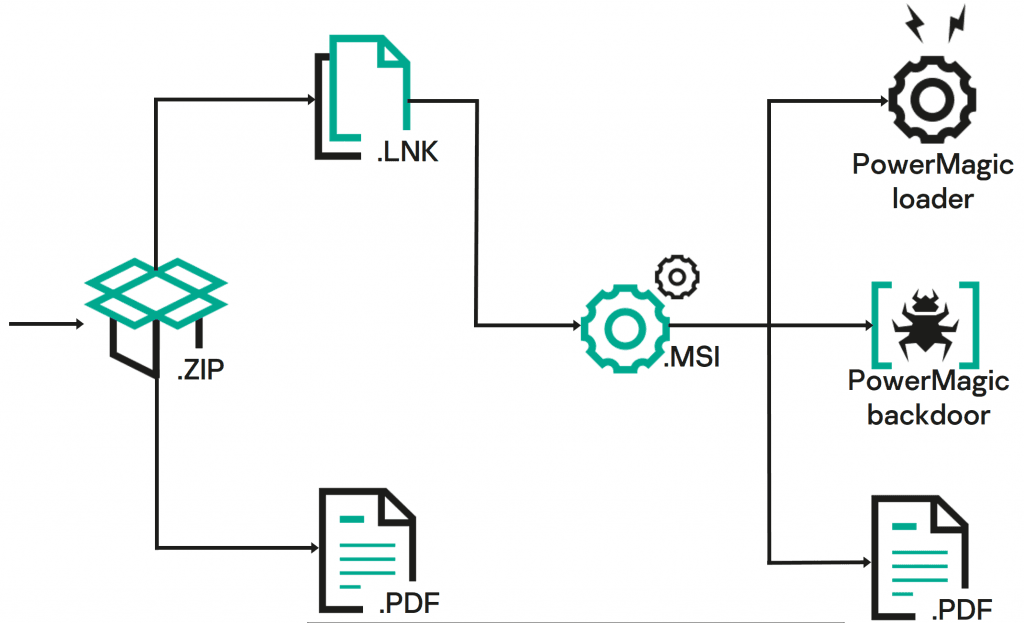
Researchers believe that threat actors use spear phishing as an initial attack vector, the messages include an URL pointing to a ZIP archive hosted on a web server under the control of the attackers. The archive contained two files, a decoy document (i.e. PDF, XLSX and DOCX versions) and a malicious LNK file with a double extension (i.e., .pdf.lnk) used to start the infection and deploy the PowerMagic backdoor.

Kaspersky attributes the attack to a new APT group operating in the area of Russo-Ukrainian conflict and tracked as Bad magic.

The experts noticed that TTPs observed during this campaign have no direct link to any known campaigns.
PowerMagic is a PowerShell backdoor that executes arbitrary commands sent by C2, then it exfiltrates data to cloud services like Dropbox and Microsoft OneDrive.
“When started, the backdoor creates a mutex – WinEventCom. Then, it enters an infinite loop communicating with its C&C server, receiving commands and uploading results in response. It uses OneDrive and Dropbox folders as transport, and OAuth refresh tokens as credentials.” reads the report published by Kaspersky.
The threat actor likely used the PowerMagic backdoor to deliver the modular CommonMagic framework.
Each module of the CommonMagic framework is used to perform a certain task, such as communicating with the C2 server, encrypting and decrypting C2 traffic, and executing plugins.
Kaspersky analyzed two plugins respectively used to capture screenshots every three seconds and collects the contents of the files with the following extensions from connected USB devices: .doc, .docx. .xls, .xlsx, .rtf, .odt, .ods, .zip, .rar, .txt, .pdf.
“So far, we have found no direct links between the samples and data used in this campaign and any previously known actors.” concludes the report. “However, the campaign is still active, and our investigation continues. So, we believe that further discoveries may reveal additional information about this malware and the threat actor behind it.”
Follow me on Twitter: @securityaffairs and Facebook and Mastodon
(SecurityAffairs – hacking, CommonMagic)


