
https://twitter.com/3xp0rtblog/status/1710387356979560800
Rapid7 researchers warn of the suspected exploitation of a recently disclosed critical security flaw (CVE-2023-46604) in the Apache ActiveMQ.
Cybersecurity researchers at Rapid7 are warning of the suspected exploitation of the recently disclosed critical vulnerability CVE-2023-46604 in the Apache ActiveMQ.
Apache ActiveMQ is an open-source message broker software that serves as a message-oriented middleware (MOM) platform. It is developed by the Apache Software Foundation and written in Java. ActiveMQ provides messaging and communication capabilities to various applications, making it easier for them to exchange data and communicate asynchronously.
Rapid7 identified exploitation attempts of the CVE-2023-46604 flaw to deploy HelloKitty ransomware in two different customer environments.
“In both instances, the adversary attempted to deploy ransomware binaries on target systems in an effort to ransom the victim organizations. Based on the ransom note and available evidence, we attribute the activity to the HelloKitty ransomware family, whose source code was leaked on a forum in early October.” reads the report published by Rapid7. “Rapid7 observed similar indicators of compromise across the affected customer environments, both of which were running outdated versions of Apache ActiveMQ.”
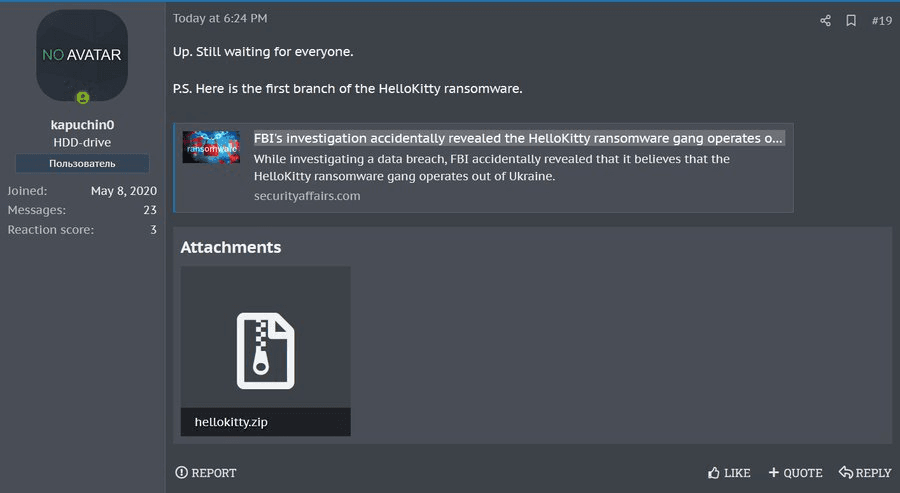
The attackers attempted to deploy the HelloKitty ransomware, whose source code was leaked on a cybercrime forum in early October
CVE-2023-46604 is a remote code execution vulnerability that impacts Apache ActiveMQ. A remote attacker with network access to a broker can exploit this flaw to run “arbitrary shell commands by manipulating serialized class types in the OpenWire protocol to cause the broker to instantiate any class on the classpath.”
Apache addressed the flaw with the release of new versions of ActiveMQ on October 25, 2023. The researchers pointed out that the proof-of-concept exploit code and vulnerability details are both publicly available.
The vulnerability affects the following versions –
- Apache ActiveMQ 5.18.0 before 5.18.3
- Apache ActiveMQ 5.17.0 before 5.17.6
- Apache ActiveMQ 5.16.0 before 5.16.7
- Apache ActiveMQ before 5.15.16
- Apache ActiveMQ Legacy OpenWire Module 5.18.0 before 5.18.3
- Apache ActiveMQ Legacy OpenWire Module 5.17.0 before 5.17.6
- Apache ActiveMQ Legacy OpenWire Module 5.16.0 before 5.16.7
- Apache ActiveMQ Legacy OpenWire Module 5.8.0 before 5.15.16
Since the bug’s disclosure, a proof-of-concept (PoC) exploit code and additional technical specifics have been made publicly available, with Rapid7 noting that the behavior it observed in the two victim networks is “similar to what we would expect from the exploitation of CVE-2023-46604.”
Post-exploitation, the attackers attempted to load remote binaries named M2.png and M4.png using MSIExec. The researchers noticed that in one of the incidents Rapid7 observed, there were more than half a dozen unsuccessful attempts to encrypt assets.
Rapid7 published Indicators of Compromise (IoCs) for these attacks.
Follow me on Twitter: @securityaffairs and Facebook and Mastodon
(SecurityAffairs – hacking, CVE-2023-46604)
Tags


