
Security Affairs
Pegasus Used Against MEP Investigating Pegasus, Citizen Lab Finds|JADEPUFFER: First End-to-End AI-Driven Ransomware Operation|The Anatomy of a Shadow AI Supply-Chain Breach: Lessons from the 2026 Vercel Incident|Law enforcememt operation disrupted Malicious Residential Proxy Networks NetNut|Government and Healthcare Are the Weakest Links in Global Email Security|Europe Confirms Record €4.1B Penalty Against Google for Android Practices|U.S. CISA adds a Microsoft SharePoint Server flaw to its Known Exploited Vulnerabilities catalog|430,000 FortiGate Devices Exposed in FortiBleed Ransomware Link|Adobe fixed multiple maximum-severity flaws in ColdFusion and Campaign Classic|Alleged Scattered Spider Hacker Extradited to U.S. to Face Cybercrime Charges|Oracle E-Business Suite Flaw Under Active Attack, 950 Systems Exposed|Azure CLI Targeted in LSHIY Password Spray Campaign Across 64 Orgs|Pegasus Used Against MEP Investigating Pegasus, Citizen Lab Finds|JADEPUFFER: First End-to-End AI-Driven Ransomware Operation|The Anatomy of a Shadow AI Supply-Chain Breach: Lessons from the 2026 Vercel Incident|Law enforcememt operation disrupted Malicious Residential Proxy Networks NetNut|Government and Healthcare Are the Weakest Links in Global Email Security|Europe Confirms Record €4.1B Penalty Against Google for Android Practices|U.S. CISA adds a Microsoft SharePoint Server flaw to its Known Exploited Vulnerabilities catalog|430,000 FortiGate Devices Exposed in FortiBleed Ransomware Link|Adobe fixed multiple maximum-severity flaws in ColdFusion and Campaign Classic|Alleged Scattered Spider Hacker Extradited to U.S. to Face Cybercrime Charges|Oracle E-Business Suite Flaw Under Active Attack, 950 Systems Exposed|Azure CLI Targeted in LSHIY Password Spray Campaign Across 64 Orgs|
Advertisement

Ad Placeholder

Full Width × 90

Breaking News

Project Zero researcher found unpatched Android zero-day likely exploited by NSO group

Google Project Zero researcher Maddie Stone discovered a critical unpatched zero-day vulnerability affecting the Android mobile operating system. Maddie Stone, a member of the Google elite team Project Zero, discovered a critical unpatched zero-day vulnerability affecting the Android mobile operating system. According to the expert, the bug, tracked as CVE-2019-2215, was allegedly being used or […]

Android zero-day

Google Project Zero researcher Maddie Stone discovered a critical unpatched zero-day vulnerability affecting the Android mobile operating system.

Maddie Stone, a member of the Google elite team Project Zero, discovered a critical unpatched zero-day vulnerability affecting the Android mobile operating system. According to the expert, the bug, tracked as CVE-2019-2215, was allegedly being used or sold by the controversial surveillance firm NSO Group.

Maddie Stone published technical details and a proof-of-concept exploit for the high-severity security vulnerability, seven days after she reported it to the colleagues of the Android security team.

https://twitter.com/maddiestone/status/1179918644089774081

The flaw is a use-after-free vulnerability that affects the Android kernel’s binder driver, it could be exploited by a local privileged attacker or a malicious app to escalate privileges to gain root access to a vulnerable device. Experts warn it could potentially allow to fully compromise the device.

“There is a use-after-free of the wait member in the binder_thread struct in the binder driver at /drivers/android/binder.c.” reads the security advisory.

“As described in the upstream commit: “binder_poll() passes the thread->wait waitqueue that can be slept on for work. When a thread that uses
epoll explicitly exits using BINDER_THREAD_EXIT, the waitqueue is freed, but it is never removed from the corresponding epoll data structure. When
the process subsequently exits, the epoll cleanup code tries to access the waitlist, which results in a use-after-free.”

The flaw affects versions of Android kernel released before April last year. This vulnerability was addressed in Dec 2017 in the 4.14 LTS kernel [1], AOSP android 3.18 kernel [2], AOSP android 4.4 kernel [3], and AOSP android 4.9 kernel [4]. The expert pointed out that Pixel 2 with most recent security bulletin is still vulnerable based on source code review.

This means that most of the Android devices available on the market with the unpatched kernel are still vulnerable to this vulnerability, even is the owners have installed the latest Android security updates.

Some of the devices which appear to be vulnerable based on source code review are:

1) Pixel 2 with Android 9 and Android 10 preview (https://android.googlesource.com/kernel/msm/+/refs/heads/android-msm-wahoo-4.4-q-preview-6/)
2) Huawei P20
3) Xiaomi Redmi 5A
4) Xiaomi Redmi Note 5
5) Xiaomi A1
6) A3
7) Moto Z3
8) Oreo LG phones (run according to )
9) Samsung S7, S8, S9

Maddie Stone explained that the flaw is accessible from inside the Chrome sandbox, the issue is exploitable in Chrome’s renderer processes under Android’s ‘isolated_app’ SELinux domain. This means that a remote attacker could potentially exploit the flaw by chaining it with a Chrome rendering issue.

“The bug is a local privilege escalation vulnerability that allows for a full compromise of a vulnerable device. If the exploit is delivered via the web, it only needs to be paired with a renderer exploit, as this vulnerability is accessible through the sandbox.” Stone said.

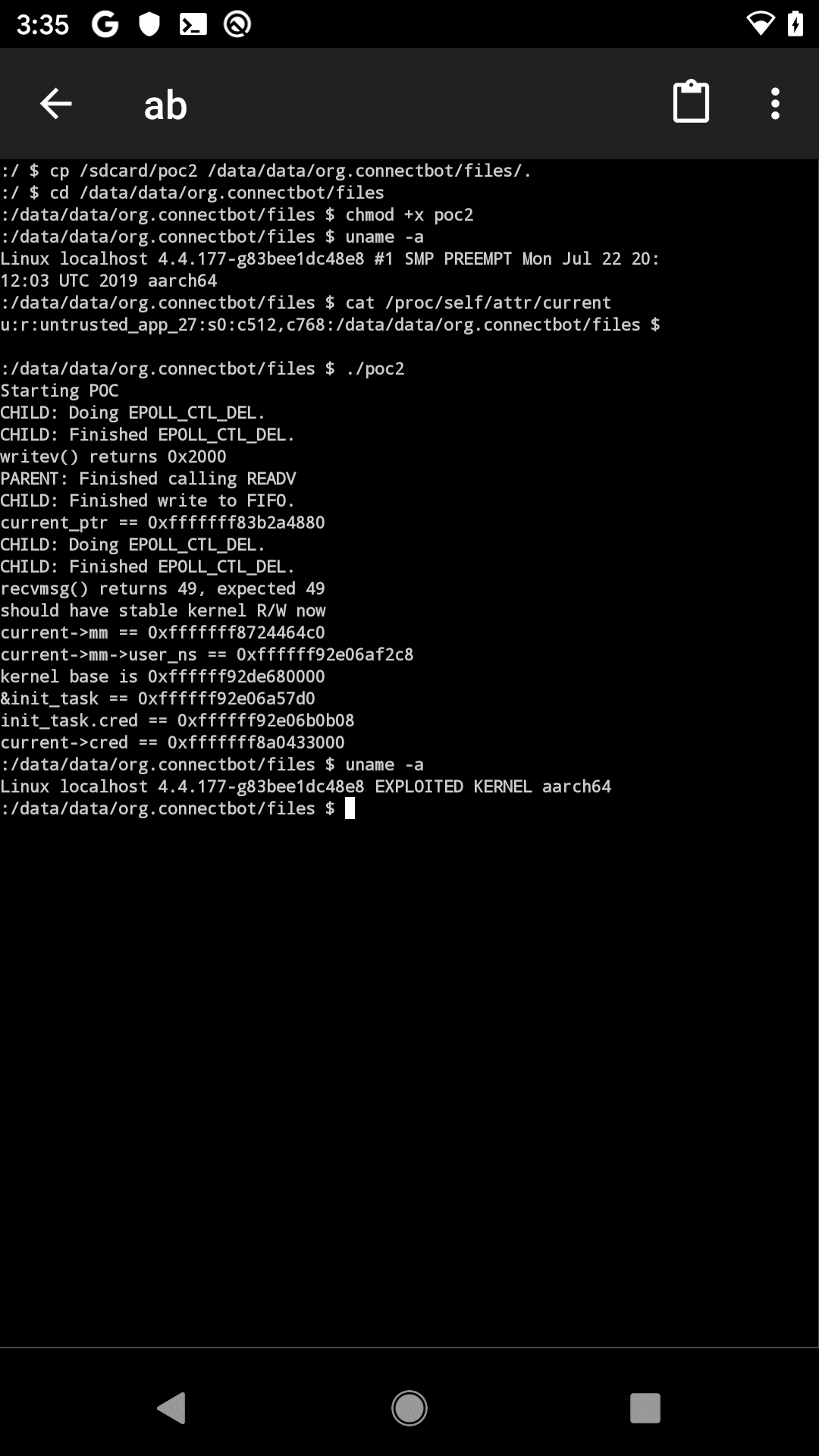
“I’ve attached a local exploit proof-of-concept to demonstrate how this bug can be used to gain arbitrary kernel read/write when run locally. It only requires untrusted app code execution to exploit CVE-2019-2215.”

Google is expected to release a security patch for its October’s Android Security Bulletin.

“This issue is rated as High severity on Android and by itself requires installation of a malicious application for potential exploitation. Any other vectors, such as via web browser, require chaining with an additional exploit,” concludes the Chromium blog. “We have notified Android partners, and the patch is available on the Android Common Kernel. Pixel 3 and 3a devices are not vulnerable while Pixel 1 and 2 devices will be receiving updates for this issue as part of the October update.”

[adrotate banner=”9″] [adrotate banner=”12″]

Pierluigi Paganini

(SecurityAffairs – Google, zero-day)

[adrotate banner=”5″]

[adrotate banner=”13″]


