
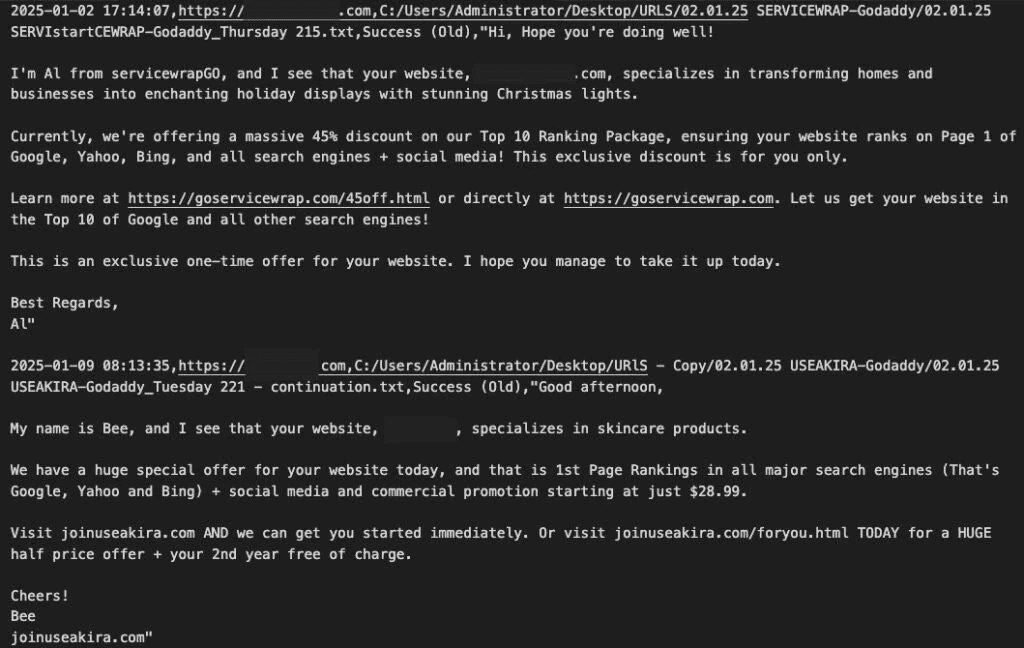
AkiraBot, a CAPTCHA-evading Python framework, has spammed over 80,000 websites with AI-generated messages, targeting small and medium-sized businesses.
SentinelOne’s SentinelLabs researchers warn that AkiraBot, a spam framework, targets websites’ chats and contact forms to promote low-quality SEO services,
AkiraBot has already targeted more than 400,000 websites and successfully spammed at least 80,000 websites since September 2024.
AkiraBot uses LLM-generated content and rotating attacker-controlled domains to bypass spam filters. The spam framework evades CAPTCHA and network detection using proxies, unrelated to the Akira ransomware group.
The name AkiraBot comes after its “Akira” SEO domains, it was spotted targeting websites like Shopify, GoDaddy, and Wix.
“The oldest archive refers to the bot as Shopbot, likely a reference to its targeting of websites using Shopify. As the tool evolved, the targeting expanded to include websites built using GoDaddy and Wix, as well as generic website contact forms, which includes websites built using Squarespace, and likely other technologies.” reads the report published by SentinelOne. “These technologies are primarily used by small- to medium-sized businesses for their ease in enabling website development with integrations for eCommerce, website content management, and business service offerings.”
The experts have discovered multiple versions active since Sept 2024, all using hardcoded OpenAI API keys and proxies. The spam framework targets contact forms and live chat widgets, runs on Windows servers, and features a GUI for multi-threaded spam across many websites.
AkiraBot uses OpenAI’s GPT-4o-mini to generate unique spam messages for each site by scraping website content with BeautifulSoup and inserting it into custom templates. The use of an LLM-based approach makes spam harder to detect and filter since each message appears personalized.

AkiraBot evades CAPTCHA services, such as hCAPTCHA and reCAPTCHA, using Selenium WebDriver to mimic user behavior and, if needed, falls back on bypass services like Capsolver. It also avoids network detection by routing traffic through SmartProxy using shared credentials.
AkiraBot logs spam activity in submissions.csv, showing over 80,000 successful spams and 420,000 targeted domains. It logs failures separately and uses Telegram bots in some versions to report success metrics.
AkiraBot’s monitor.py uses pyautogui to paste JavaScript into browser consoles, automating CAPTCHA bypass. It logs success to Telegram, handles proxy rotation, and tracks CAPTCHA status via stats.json. All versions analyzed used the same Telegram token and chat ID.
The researchers noticed that the spam domains rotate frequently to evade detection. The oldest, akirateam[.]com, dates to Jan 2022. DNS records link domains like servicewrap-go[.]com to 77980.bodis[.]com, a known malvertising host. Connections suggest ties to unj[.]digital, a digital marketing site with suspicious activity.
AkiraBot-linked SEO sites use “Akira” and “ServiceWrap” branding. Their TrustPilot pages show many 5-star reviews with similar, likely AI-generated content, and occasional 1-star reviews calling them scams or spammy. Review patterns suggest possible fake reviews, though not conclusively proven.
“AkiraBot is a sprawling framework that has undergone multiple iterations to integrate new spamming target technologies and evade website defenses. We expect this campaign to continue to evolve as website hosting providers adapt defenses to deter spam.” SentinelLab concludes. “The author or authors have invested significant effort in this bot’s ability to bypass commonly used CAPTCHA technologies, which demonstrates that the operators are motivated to violate service provider protections.”
Follow me on Twitter: @securityaffairs and Facebook and Mastodon
(SecurityAffairs – hacking, spam)


