
Researchers at Proofpoint discovered a massive AdGholas Malvertising Campaign infecting as many as 1 million computers per day with several banking trojans.
A new massive AdGholas malvertising network discovered by experts at Proofpoint has been infecting as many as 1 million computers per day with several banking trojans.
AdGholas operators have been active since 2015, the threat actors behind the AdGholas malvertising campaign was notable for its use of steganography and careful targeting of the massive volume of malicious ads and impressions and its ability to avoid detection of researchers.
“Proofpoint researchers have discovered and analyzed a massive malvertising network operating since 2015. Run by a threat actor we designated as AdGholas and pulling in as many as 1 million client machines per day” states the analysis from Proofpoint.
According to Proofpoint researchers “This campaign represents the first documented use of steganography in a drive-by malware campaign, and attacks employed ‘informational disclosure’ bugs perceived to be low-risk in order to stay below the radar of vendors and researchers.”
The campaign was receiving high-quality traffic from a variety of high-rank referrers, from more than twenty different AdAgency/AdExchange platforms. According to the experts, the AdGholas was clocking one to five million hits every day, unfortunately, roughly 10-20% of the hits were redirected to domains hosting exploit kits.
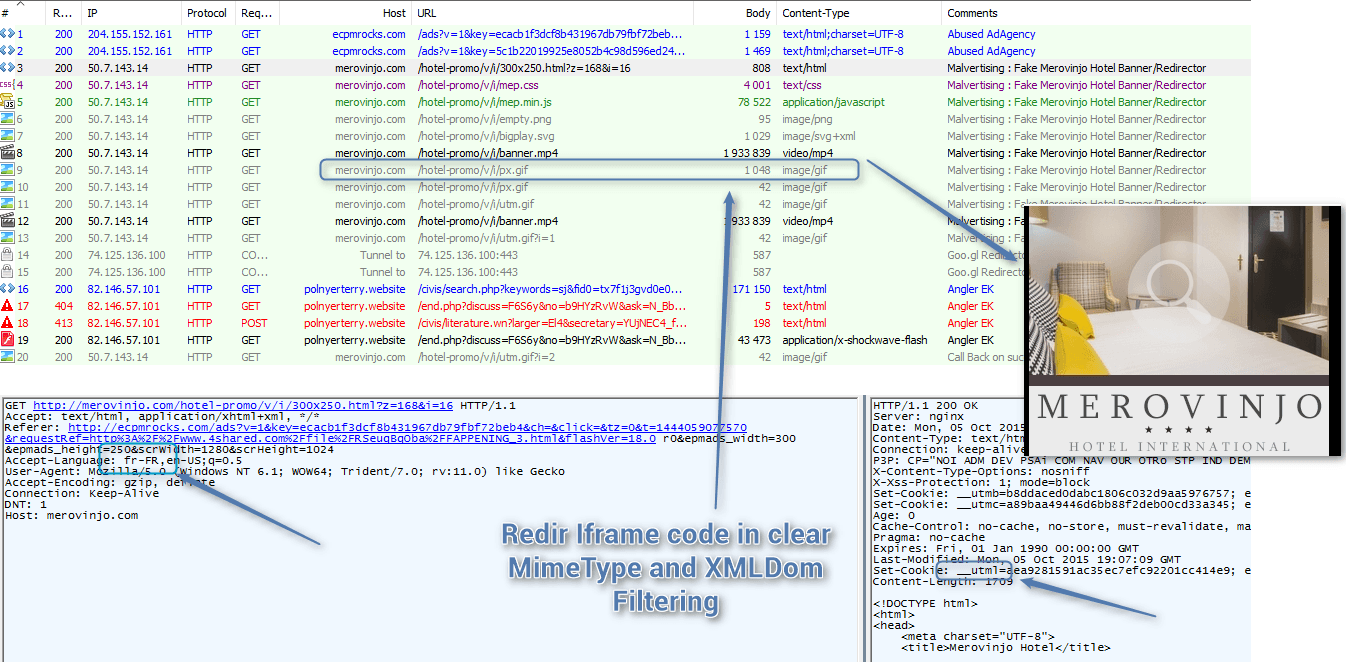
Cyber criminals were using domains that appear as clones of legitimate websites belonging to Hotel Merovinjo in Paris, Ec-centre and Mamaniaca.

The experts at Proofpoint observed that hackers served different malware depending on user and geography.

“Our analysis with colleagues from Trend Micro found that AdGholas campaigns do not all work the same way, but all do have the same multi-layered filtering and obfuscation,” continues the analysis. “For instance, the redirect tag is being sent in several ways. We saw the xhr-sid sent as response header to a POST to GIF, but it is sometimes hidden at the end of an ‘addStat hash in the initial landing.”
AdGholas gang went silent for two weeks after the Angler exploit kit disappearance from the threat landscape, it then returned using the same domains at the end of June in campaign leveraging the Neutrino EK.
Malware researchers observed the gang delivering geo-focused banking Trojans, such as Gozi ISFB in Canada, Terdot.A (aka DELoader) in Australia, Godzilla loaded Terdot.A in Great Britain, and Gootkit in Spain. The experts observed four different Neutrino threads, as Neutrino is not including an internal TDS while Blackhole, Angler and Nuclear were.
Recently the AdGholas gang or close distribution partners was operating reverse proxies serving the involved instance of exploit kit at the end of April.
AdGholas demonstrates that malvertising campaigns are becoming increasingly sophisticated to remain stealthy and effective.
Below key findings from Proofpoint analysis:
- Massive scale: The AdGholas network drew traffic of 1-5 million high quality client hits per day.
- Stealthy innovation: This campaign represents the first documented use of steganography in a drive-by malware campaign, and attacks employed “informational disclosure” bugs perceived to be low-risk in order to stay below the radar of vendors and researchers.
- Sophisticated filtering: AdGholas employs ‘smart,’ multi-step filtering techniques to more precisely target client systems, including avoiding non-OEM and non-Nvidia/ATI-powered systems.
- Convincing: Redirected sites avoid suspicion and improve effectiveness by closely mimicking the appearance of the legitimate site expected by the ad agencies.
[adrotate banner=”9″]
(Security Affairs – AdGholas, malvertising)
[adrotate banner=”13″]


