
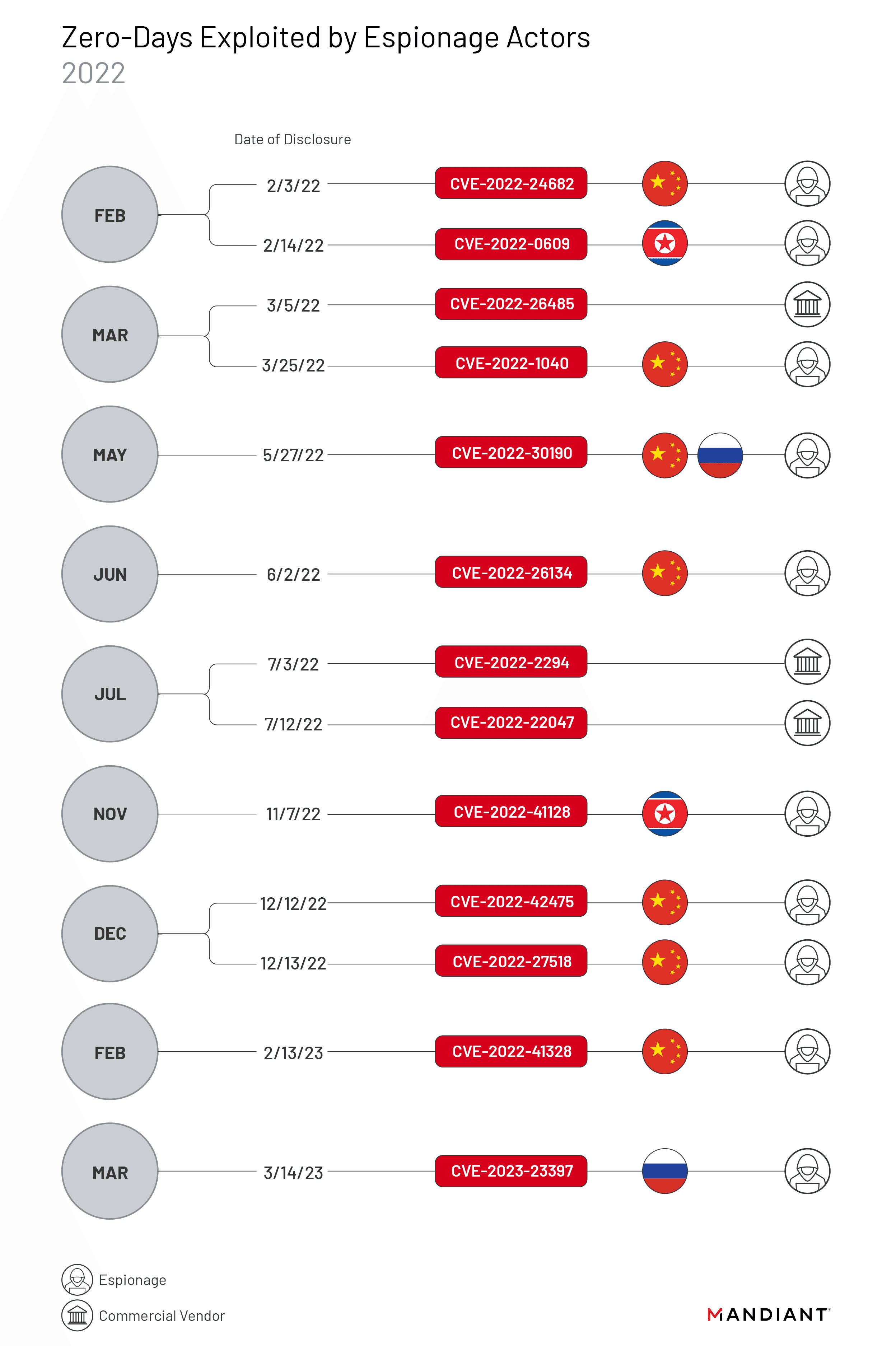
Experts warn that 55 zero-day vulnerabilities were exploited in attacks carried out by ransomware and cyberespionage groups in 2022.
Cybersecurity firm Mandiant reported that ransomware and cyberespionage groups exploited 55 zero-day flaws in attacks in the wild.
Most of the zero-day vulnerabilities were in software from Microsoft, Google, and Apple.
The figures show a decrease from 2021, but experts pointed out that they represent almost triple the number from 2020.

The majority of the zero-day vulnerabilities were exploited by China-linked threat actors as part of their cyberespionage campaigns.
The researchers reported that only four zero-day vulnerabilities were exploited by financially motivated threat actors, with 75% of these instances linked to ransomware attacks.
“Products from Microsoft, Google, and Apple made up the majority of zero-day vulnerabilities in 2022, consistent with previous years. The most exploited product types were operating systems (OS) (19), followed by browsers (11), security, IT, and network management products (10), and mobile OS (6). ” reads the report published by Mandiant.
According to the report, 13 zero-days in 2022 were exploited by cyber espionage groups, a figure that is consistent with 2021. Seven zero-days (CVE-2022-24682, CVE-2022-1040, CVE-2022-30190, CVE-2022-26134, CVE-2022-42475, CVE-2022-27518, and CVE-2022-41328) were exploited in attacks in the wild by China-linked cyberespionage groups, while two zero-day vulnerabilities were exploited by suspected North Korea-linked APT groups.
“We identified four zero-day vulnerabilities for which we could attribute exploitation by financially motivated threat actors, a quarter of the total 16 zero-days for which we could determine a motivation for exploitation. 75% of these instances appear to be linked to ransomware operations, consistent with 2021 and 2019 data in which ransomware groups exploited the highest volume of zero-day vulnerabilities compared to other financially motivated actors.” continues the report. “However, the overall count and proportion of the total of financially motivated zero-day exploitation declined in 2022 compared to recent years.”

Multiple China-linked APT groups exploited the vulnerability CVE-2022-30190, aka Follina, while the exploitation of FortiOS vulnerabilities CVE-2022-42475 and CVE-2022-41328 was observed in particularly notable campaigns in 2022.
Mandiant believe that there is a shared development and logistics infrastructure behind the attacks.
Mandiant also observed two instances of Russian state zero-day exploitation. A first campaign carried out by the Russia-linked APT28 group exploited the CVE-2022-30190 flaw (aka Follina) in early June 2022. A second activity is related to a months-long campaign exploiting Microsoft Exchange vulnerability CVE-2023-23397 conducted by a threat actor tracked as UNC4697 (likely linked to the APT28 group).
The experts explained that increased focus on disrupting Russian cyber operations since Russia’s invasion of Ukraine may have discouraged Russia-linked groups from widely using zero-day exploits for access they expected to lose quickly. This implies that the exploitation of the CVE-2022-30190 flaw was likely opportunistic.
“Almost all 2022 zero-day vulnerabilities (53) were exploited for the purpose of achieving either (primarily remote) code execution or gaining elevated privileges, both of which are consistent with most threat actor objectives. While information disclosure vulnerabilities can often gain attention due to customer and user data being at risk of disclosure and misuse, the extent of attacker actions from these vulnerabilities is often limited.” concludes the report. “Alternatively, elevated privileges and code execution can lead to lateral movement across networks, causing effects beyond the initial access vector.”
Follow me on Twitter: @securityaffairs and Facebook and Mastodon
(SecurityAffairs – hacking, zero-day)


