
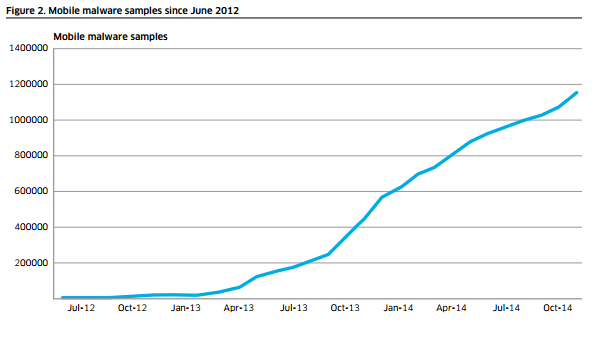
A recent study published by Alcatel-Lucent’s Motive Security Labs reported that 16 million mobile devices worldwide have been infected by malware.
Security experts noticed a significant increase in cyber threats to mobile and residential devices and attacks on communications networks in 2014. A growing number of sophisticated attacks are threatening personal and corporate information representing a serious menace to the security of enterprises and users’ privacy.
The “Motive Security Labs H2 2014 Malware Report” published by Alcatel-Lucent’s Motive Security Labs provided a detailed analysis of trends and statistics for malware infections in devices.
The experts confirmed an acceleration in the growth of infections related to mobile devices, with an increase of 25% in 2014, compared with 20% in 2013.
“Currently, 0.68% of mobile devices are infected with malware. This is a growth of 25% in 2014. We can use this infection rate to calculate the total number of infected smartphones worldwide. According the ITU there are currently 2.3 billion mobile broadband subscriptions, so we estimate that 16 million mobile devices had some sort of malware infection in December 2014. This global estimate is likely on the conservative side because our sensors do not have complete coverage in areas such as China and Russia, where mobile infection rates are known to be higher than average. ” states the report.

In December 2014 the infection rate reached 0.68% that corresponds nearly 16 million mobile devices infected on a global scale.

The experts confirmed that the malware targeting mobile devices is increasing in sophistication, among principal cyber threats that are targeting the industry there are Mobile spyware.
“In terms of malware trends, on the mobile side we have seen more sophisticated malware crossing over from the Windows/PC realm and also in the area of mobile spyware that tracks the victim’s calls, text messages and location. On the residential side, we have seen a significant increase in adware with 14 out of the top 20 being in that category.” continues the report.
Mobile devices infections were equally divided between Android devices and Windows/PCs, it is interesting to note that mobile devices of other vendors, including Apple and Blackberry, account with less than 1%.

The report also refers the reluctance of users in shopping online with mobile device due to the fear to be their credit or debit card information may be stolen by crooks.
The numerous data breaches that hit retail industry was the primary cause for credit and debit card data theft.
Below the highlights of the report:
2014 highlights Mobile
- On the mobile side, infections continue to accelerate, with an increase of 25% in 2014, compared with 20% for 2013.The infection rate is currently at 0.68%. Based on this, we estimate that worldwide, about 16 million mobile devices are infected.
- The infection rate is currently at 0.68%. Based on this, we estimate that worldwide, about 16 million mobile devices are infected by malware.
- Mobile malware is increasing in sophistication with more robust command and control (C&C) protocols. Mobile spyware is definitely on the increase. Six of the mobile malware top 20 list are mobile spyware. These are apps that are used to spy on the phone’s owner. They track the phone’s location, monitor ingoing and outgoing calls and text messages, monitor email and track the victim’s web browsing.
- The infections were split 50/50 between Android devices and Windows/PCs, with less than 1% coming from other smartphones such as the iPhone and Blackberry. Windows/PCs remain the workhorse of cybercrime, but the Android platform is catching up.
Residential
- The overall monthly infection rate in residential fixed broadband networks is currently at just under 14%. This is up substantially from the 9% we saw in 2013. The increase is mostly attributable to a large increase in moderate-threat-level adware infections. High-level threats such as a bots, rootkits and banking Trojans remain steady at around 5%.
- High-level threats such as a bots, rootkits and banking Trojans remain steady at around 5%.
(Security Affairs – Android, Mobile devices)


