
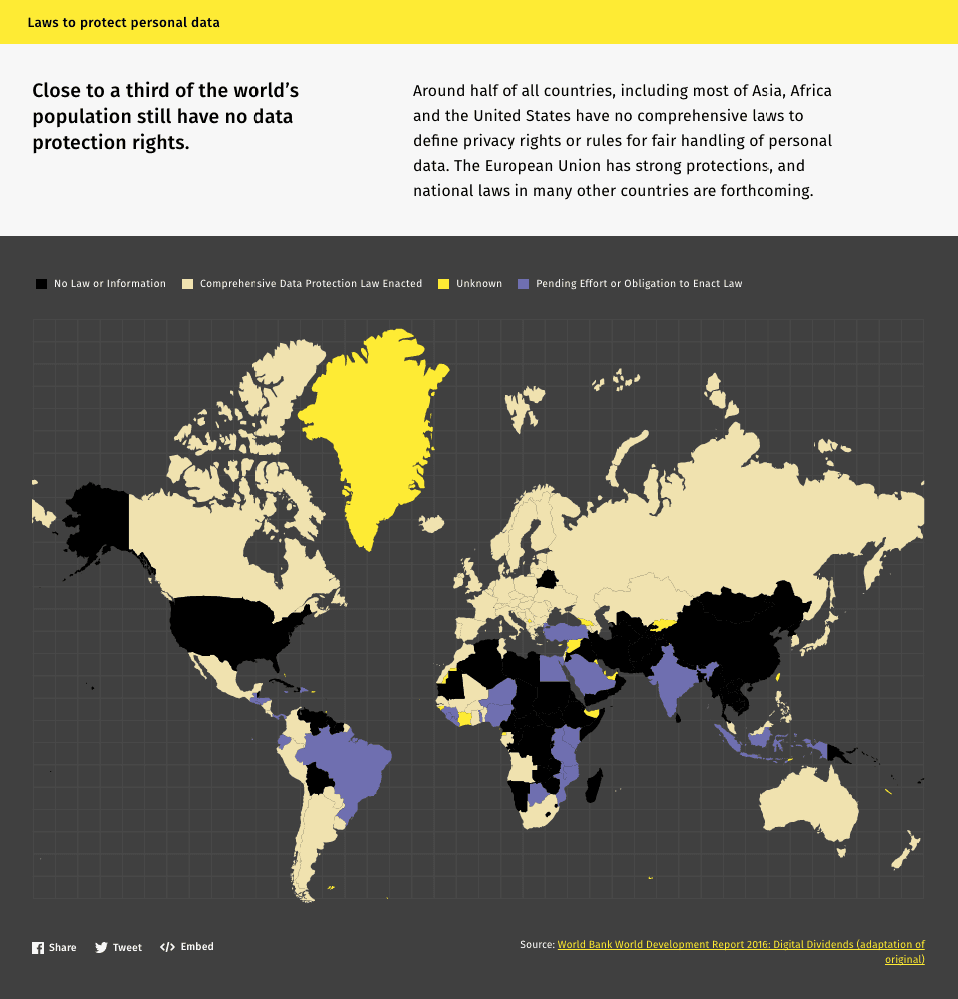
The Mozilla foundation has published its first Internet Health Report to analyze the dangers of the Internet that we can consider as a global commodity.
The Mozilla foundation has published its first Internet Health Report to analyze the dangers of the Internet that we can consider as a global commodity.
The oligarchy of internet companies. internet monitoring, censorship and new threats posed by Internet of Things devices every day menace our privacy.
Mozilla aims to track the health of the Internet focusing on aspects such as the Open Innovation, Digital Inclusion, Decentralization, Privacy and Security and Web literacy.
“We want to work with people and organizations that care about a healthy internet to engage the general public in caring more deeply about ‘internet health,’ in the way that the environmental movement was able to grow mainstream using terms like ‘global warming’ that no one previously had heard of,” explained the editor Solana Larsen.
Positive news from the security and privacy perspective, communications over the Internet is more secure thanks to the efforts of organizations and private companies.
The Internet Health Report appreciates the adoption of end-to-end encryption by messaging apps and other web services and welcomes the upcoming new version of the Transport Layer Security (TLS 1.3) cryptographic protocol that will make the web more secure and fast.

“More messaging apps, including WhatsApp, now offer end-to-end encryption, meaning that conversations are protected from eavesdroppers, including the service provider.” states the report.
“Web traffic encryption is rising too. One factor is the launch of Let’s Encrypt, a new certificate authority that makes it easy and free to add HTTPS to any website. This helps protect the privacy of users, and offers some guarantee they are not looking at spoof pages. Also driving adoption, search engines and browsers are now subtly rewarding HTTPS websites.
Unknown to most, Internet communication will be more private, and possibly also faster, due to an upcoming new version of the cryptographic protocol called Transport Layer Security (TLS 1.3) that is used to secure all communications between Web browsers and servers.”
Unfortunately, snooping powers continues to grow, several states continues to spend a significant effort in surveillance activities threatening users’ privacy.
“There is more public scrutiny of surveillance laws than before, but it hasn’t stopped greater snooping powers from being proposed in Britain, Pakistan, France and several other countries,” states the report.
The report also warns of the risks related to a rapid and uncontrolled diffusion of unsecured IoT device. The lax of security is the root cause for the success of botnet like Mirai and open the door to surveillance and hacking activities.
“In November 2016, a malware program called Mirai mobilized 100,000 connected devices, including webcams and baby monitors, in a distributed denial-of-service attack (DDOS) that briefly took down parts of the internet,” states the report.
“The owners of those compromised devices may never know (or care) what happened, and cheap and insecure devices will continue to be manufactured, unless safety standards, rules and accountability measures take hold,” they said.
Mozilla Foundation is calling to action everyone to improve and ensure security and privacy.
“Above all, we should be more critical about what information we share voluntarily. Will the online dating profile you posted 6 years ago ever get deleted? How long do the online ads you view track you? Even if you’d like to know the privacy conditions of online platforms, they are usually not written in English,” closes the report.
[adrotate banner=”9″]
(Security Affairs – Internet Health Report, Privacy)


